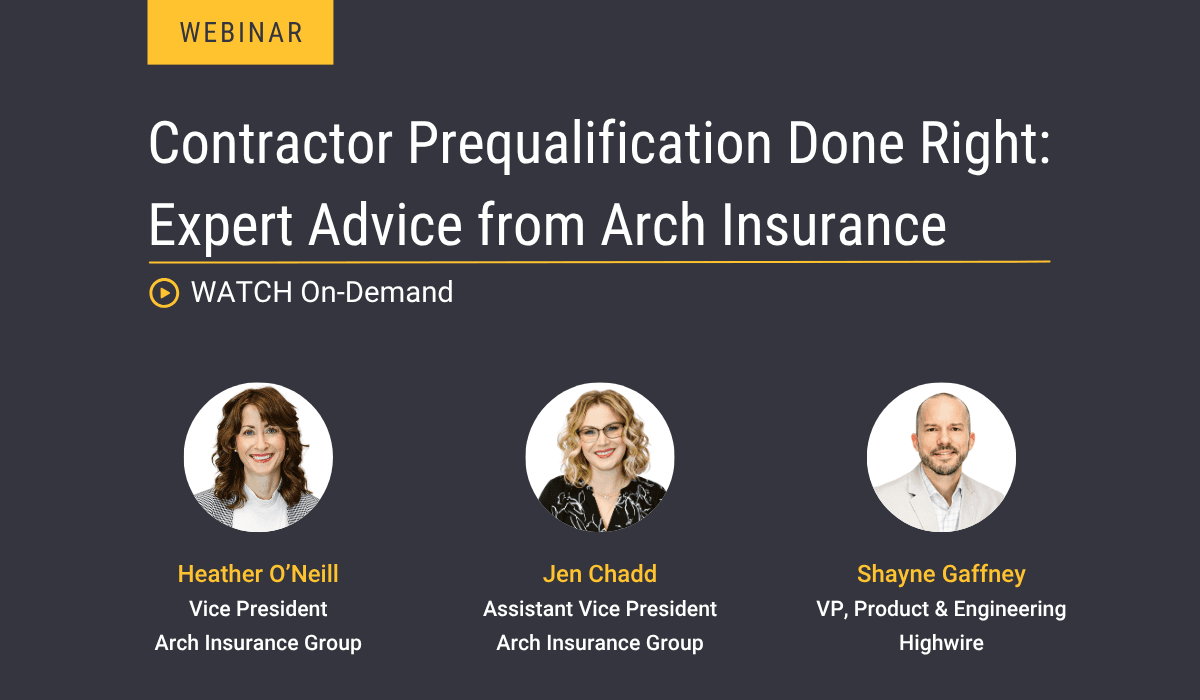
Contractor Prequalification: Expert Advice with Arch Insurance
In this episode, Shayne Gaffney, VP of Product & Engineering at Highwire, speaks with Heather O'Neill, VP of Construction Specialty Products, and Jen Chadd, AVP of Senior Commercial Line Underwriter at Arch Insurance, about how strong prequalification practices can reduce risk and boost profitability.
With deep experience in subcontractor default insurance (SDI), Heather and Jen explain why subcontractor evaluation must be an ongoing process, not a one-time event, and how it helps uncover hidden risks.
They discuss the evolution of SDI, the need for financial transparency, and the importance of aligning finance, operations, and risk teams. The episode also explores how tech can streamline prequalification workflows and what’s next for the industry.
Whether you’re new to SDI or refining your approach, this episode offers practical insights to build a more resilient business.
To learn more about Arch Insurance, visit insurance.archgroup.com
Meet the Guests

Heather O'Neill
Arch Insurance Group Inc., Vice President, Construction Specialty Products
Heather O’Neill is Vice President of Construction Specialty Products at Arch Insurance, where she leads strategy and underwriting for subcontractor default insurance (SDI) solutions. With over two decades of experience dedicated to SDI and Construction Insurance, Heather has supported top general contractors nationwide in managing subcontractor risk.

Jen Chadd
Arch Insurance Group Inc., AVP, Construction Specialty Products
Jen Chadd is Assistant Vice President of Subcontractor Default Insurance (SDI) at Arch Insurance. Leveraging over seven years of SDI underwriting experience in conjunction with a background in financial analytics and strategic planning, Jen specializes in helping contractors implement SDI programs that strengthen project resilience and financial outcomes.
Related Resources

Transcript
[00:00:50] Shayne: All right.
Today's session, I'm very excited for. It's all about how strong prequalification practices can reduce risk and drive profitability. I'm Shayne Gaffney. I'm VP of Product and Engineering here at Highwire, and I'm excited to be joined by two industry leaders from Arch Insurance, Heather O'Neill and Jen Chadd.
Heather and Jen, could you introduce yourselves a bit and tell us your background, and really, how you came to Arch?
[00:01:17] Heather: Yeah, absolutely, and I'll start. Thanks for having us today. I'm Heather O'Neill. I'm Vice President, part of the SDI underwriting team at Arch. I've actually been at Arch for five years.
Previous to that, I was underwriting SDI and another carrier for six years. I've been in construction insurance pretty much my entire career. Spent time on the broker side and started at a captive for contractors based in Dallas, which I always joke, and people have heard me say this, it's exactly what I thought I was gonna do with my history and English degrees.
But it has been an awesome career, and I'm excited to talk about prequal with you guys today.
[00:01:55] Shayne: Likewise. All right, Jen, go for it.
[00:01:58] Jen: Great. Um, Jen Chadd, I've been with Arch for about four years.
Prior to that, I was with another SDI carrier for a couple years. And then my career background has really been in landscape architecture and finance. I have a degree in landscape architecture and an MBA with a finance focus. So, been construction adjacent the majority of my career.
[00:02:19] Shayne: Great. Thank you for those intros. Really awesome to meet you both.
Uh, tell us a little bit about the clients you work with and how Arch supports the construction industry.
[00:02:30] Jen: Arch is an underwriting-focused based company established in 2001, really to provide capacity, and specialized expertise in a market that was really struggling at the time. Since then, we've built a diverse platform, book of business, both in reinsurance and specialty markets. Where subcontractor default insurance sits within Arch is underneath our construction division. Specifically, we have a lot of expertise in the construction industry, and subcontractor default is just one of the many lines that we offer across construction, but I think it really shows our commitment to understanding construction in the market and all the various aspects that go into it.
[00:03:09] Heather: We really view ourselves as a specialized market focusing on regional builders. People who have a defined footprint they have offices where they built. They've spent a lot of years building out relationships with subcontractors. We see that as beneficial. We partner with people who have defined robust risk management around sub-selection. We have good quality management, typically privately owned companies.
From a program offering standpoint, I will say for those listening, if you have some specific questions for Jen and I, please reach out.
We do have a lot of flexibility in how we structure programs, but a couple things to point out. We do have up to 50 million in each loss limit capacity, and then we have flexibility in how we offer loss funding capability. So that means the ability for our contractors to fund for that retention portion.
This is just broadly our program offerings, and if you guys have questions, please reach out.
[00:04:12] Shayne: Thank you very much for explaining that.
So let's get into prequal, right? Why does that matter, and why is it so important for clients to pre-qualify their contractors?
[00:04:24] Heather: Yes. So, of defaults that we see, do you think we see the most defaults with subcontractors who've been in business one to five years, five to 10 years, 10 to 20, or over 20? To answer the question, we see the most defaults with subcontractors who have been in business over 20 years. Why I'm pointing this out and leading into our conversation around prequal is any sub can fail.
It's really important to have a robust prequalification process in place to vet your subs, to make sure that they have the capacity to complete the work that's being considered. We're all humans, and I think we have a bias towards people we know. You know, operations teams are like, Hey, we worked with this sub.
We know them. Maybe you see them on the weekend, like, of course, they're gonna be able to do this project.
Any sub, regardless of how many years they've been in business, can fail. And it's really important to stay disciplined in a process. I think everybody is really certain about a decision until you ask them, wanna bet?
Are you gonna bet the retention of your SDI program? Are you gonna bet your reputation? And that kind of switches people's mindsets to go, oh, maybe I should look at this data and actually use that to drive my decision. And just to point out, regardless of whether or not you have an SDI program, qualifying your subs is so important.
It's the majority of risk on your project. Even if you don't have SDI, there is reputational risk, the risk for profit on your job. It's really important to make sure you're choosing the right trade partners. And to get into SDI, and then I promise we're gonna get into more best practices around prequal.
SDI covers that majority of risk you have on your job. So it's a first-party indemnity policy that covers the financial risk related to sub's defaulting. So if a sub is unable to complete the contract on your project, and you have to go out and find another sub, most likely it's going to cost some multiplier more to replace that subcontract.
That financial delta is where SDI steps in. Essentially, and why prequal is so important is a lot of folks rely on sub bonds. You're changing the role, you are becoming the surety company, and evaluating your subs.
And I'm gonna kick it over to Jen to just kind of explain a little bit of that difference.
[00:07:01] Jen: So, like Heather mentioned, there's really two major risk mitigation tools when you're talking about sub-default. One would be obtaining a performance and payment bond from your subcontractors or having an SDI program. The biggest benefit of SDI, and again, it's gonna tie back to why financial prequal is so important, is SDI puts the power back into the general contractor's hand to remedy the default.
So instead of the surety coming in and deciding how they are gonna satisfy that contractual agreement from their subcontractor, the GC, who's already managing the job, you are controlling the schedule, everything else, it's putting that power back into your hand. Unlike the surety, who has a fiduciary responsibility to their subcontractor, we would have a responsibility to indemnify the general contractor. And the real main difference of that really ties to financial prequal. When you have an SDI program, you are stepping into the shoes of asurity. So you're typically relying on that surety to financially pre-qualify and guarantee that the sub is viable to complete the work. When you have an SDI program, you are stepping into those shoes of determining what that subcontractor is capable of in terms of the size of work, the aggregated amount of work that you wanna award to that subcontractor.
That, I think, sets us up to there's a real benefit to our general contractor. There's a profit benefit to SDI. You manage your risk well, you get rewarded. With that comes the need for stronger process and procedures to protect that risk since you don't have the surety performing that role for you anymore.
[00:08:41] Shayne: Sure.
[00:08:42] Jenn: Just really wanna hit on why continual financial prequalification is so important. We really encourage our GCs to pre-qualify their contractors annually, and one thing that we see is coming in and out of these different economic cycles.
What we'll really see is it's important to keep on top of what do their financials look like. Not only that, but what does their WIP look like? Are they taking on so much work because we're coming out of a recessionary period that they're gonna die from overeating versus starvation? That's really what we see a lot of times with default, and where we see the spikes of default occurring.
It's when subs have gone through a downtime, they're really struggling, and then they take on more work than they can really finance. This just really highlights why we harp on financial prequal so much, is it is at least 50% of the defaults we see are caused by financial issues, whether that's full insolvency or other cash flow issues.
But I will say, in terms of performance issues, and we qualify that as like schedule, manpower, quality per quality issues, there's typically a financial component as part of that. So to say it's only 50% is a little bit misleading. Usually, when we see a default, there is some sort of financial red flag going on at the same time.
[00:10:02] Shayne: So, I'm sure there's all sorts of different levels of programs and levels of sophistication you see day to day. Tell me a little bit about what you've seen in terms of programs and how Arch, again, will support all those different types of programs.
[00:10:17] Heather: Yeah. From a prequal program aspect, we see a wide range of folks doing things, and I will say it's really what works best for your business and what your teams will actually follow through with doing, and what you can get buy-in for. I think the hardest piece, and Jen touched on this. When people are considering SDI, that mindset change of evaluating the financials is where we see people stumble the most and need the most coaching because they're not used to it.
Most subcontractors in the markets that you all work have worked with a GC who has SDI. They're being asked for their financials. So just to encourage people, I know that's a stumbling block, and a lot of times they're like, hey, subs don't wanna show us their financials. I promise you they're showing them to someone.
[00:11:04] Jenn: Yeah, and that's a note too, even on the WIP. Like when we talk about looking at the WIP, we really are encouraging our GCs, like, you don't need to see their prof, like a lot of times, subs don't wanna show what profits they're making on other jobs. Totally fine. What you really need to see is what work do they have on their books, how much is it completed, and what work is upcoming?
[00:11:25] Heather: Yeah. So there's, again, from a program standpoint, we see people look at manual process. They're collecting a PDF prequal questionnaire. Maybe they're getting a bonding letter, and again, making that switch to asking for financials. And then when you ask for financials, actually doing something with them, having some metrics that you're looking at to assess the financial capacity of the sub.
We see people also using third-party software that helps them collect all the prequal information that they need. The subs, just standard information. What's their largest completed job? Where are they licensed? Have they had lawsuits? All of the normal things.
That also helps them collect the bonding information, the insurance information, the financials. That can be an information-capturing tool. Many third parties, including you all, have the ability to evaluate the financials, help evaluate the financial capacity for you, and help assign single and aggregate limits.
Again, we always tell people, third parties are a tool. You still have to define how you're going to use it and what happens when that subcontractor, you're looking at an award that goes above what the recommended single and aggregate is.
Just to segue, so we did wanna share with folks listening what we see as some best practices around prequal. We touched on some options that we see out there, but here's some kind of important things to consider as you might be building out your process, or maybe you have portions of this, and you're looking to build it out.
The first step is making sure you have a defined process. That it's written, that there's workflows, outlined roles and responsibilities. Who's looking at the subcontractor's project history, who's looking at their safety history, who's looking at the financials? And also some authority on that too, because a lot of times it needs to be a financial person or a risk manager who's looking at the financial piece and giving that single and aggregate limit. But having it written ensures that you have consistency across your organization and everyone knows what the process is. From a timing perspective, we talked about this earlier, it should be annual at least, that you're looking at a subcontractor's information. I think best practice is also to do a by-project look. So you're doing an annual review, and then, as you're considering them for a project to get some updated information, make sure things haven't changed, but they're still the right sub to partner with.
The information collection piece, that's what we've touched on. Information collection can happen a variety of ways. We see people do that manually. In terms of getting the pre-fall questionnaire and the other information, that's also where we talked about third parties can be helpful. The financial review piece it's a cornerstone of SDI.
It should also be a cornerstone of, regardless, how you're evaluating your subs. Making sure that you have metrics that you're using to be able to assess the subs' capacity. We see people setting single and aggregate limits as a best practice. So, a lot of times, you can look at financials and say, Hey, these financials look good, but for what size contract? Do they have the working capital to support a $2 million contract or a $10 million contract?
And that's important to understand. Liquidity is a huge portion of this and something that I encourage people to be laser-focused on right now. What is the sub’s access to cash? Whether that's through cash on their balance sheet, or line of credit, or combination.
And then having a means to assess the operational capacity and what that means. Has the subcontractor done work in this market sector? Have they done work of this size? Have you done outside reference checks if you haven't worked with them before? Are you considering a post-job evaluation and how they've performed for you in the past?
Final step, if there's anything in along these steps that kind of gives you a flag. The first question should be, should we consider the next sub if there's enough red flags? But if they're still the right partner, but there's just something that you need to button up to make sure they can get across the finish line, is assigning a risk mitigation plan. Is there an opportunity to joint check lower tiers if they're having a safety concern? Do you need to have additional supervision on the job? And having a documented plan that the project team is aware of and assigned responsibilities of who's gonna implement that is important because I think a lot of times we see best intention.
Having it documented and key responsibilities of who's gonna actually implement it. And then all of this feeding back into doing a post-job evaluation, and all of this information feeding back into the process, so you understand how the sub's performance has been, and that your pre-con and estimating teams understand all of that, and that it gets fed back through. If you were going beyond, set single and aggregate limits of 5 million, 10 million, and you're looking at them for an $8 million project, which exceeds that single limit.
Having a documented exceptions process, who needs to be aware of that decision? Is that your CFO? Is that your risk manager? Does a president or project executive? Having multi-levels sign off on that decision so that everyone understands, like, hey, this is our process. We're going beyond it. But having this documented as to why we did it is really important.
So that's just giving you guys a lot of information all at once. But this hopefully is helpful to kind of just give you an idea of what we see as best practices as you're looking to define your process.
[00:17:21] Shayne: Awesome. If we were to take it one step deeper for clients who have adopted SDI programs, what kinds of things do you advise them to really focus in on when they're looking at their subs?
[00:17:34] Jen: So, we really see this as like a three-pronged approach. Financial capacity, we'll never stop talking about it. Their experience and operational capacity, and then safety. What we find with a lot of our GCs, especially ones that are robust and sophisticated enough to start an SDI program, is they're usually pretty good at the experience, operational capacity, and safety management.
What we really tend to focus on with existing and new buyers is really that financial capacity prequal. They have a lot of questions about. Okay, well, how should we set single and ag limits? What ratio should we be looking at? And we partner with either they're partnering with another third-party, or we'll have conversations with them, or their CFO, or whoever is saying, okay, this is what we think makes sense.
Is it three times working capital, a portion of liquidity, or revenues? But that's kind of the three-pronged approach that we see. And again, a lot of times they're really good at kind of two of the legs and need some more help building up that third leg. From that, though, I did wanna give you all a sense of red flags, so we really see prequal and why we talk about it as first line of defense against sub default. And when we're talking to our GCs, a lot of times they wanna say, okay, well, what red flags have you seen pop out of defaults? What trends are you seeing? That's a really big word that we hear, and we've been able to glean out a few high points. For example, with a lot of our defaults, some, you know, we consistently will see that it's the sub's largest project ever.
They couldn't post a bond, so they were put into SDI, even if they didn't fully qualify. And that's something we talk a lot of, that's not the intent of it.
Awarding over those limits, or the biggest thing we're seeing lately, especially as subs get more busy, and there's not enough labor to go around, is that you start seeing pretty large bid spreads because some really need the work, some don't, so they'll bid it high. But really, what you see from that bid spread is that's the guaranteed amount that you're gonna have to pay in the event of a default. So it's really something to pay attention to or have a backup plan for.
Operational stuff that we see. We've seen several defaults from owner-mandated or directed subcontractors. They say, Hey, we've used them on these jobs. They're really great. You have to use them, carry the risk for 'em. We've seen GCs get into that sticky situation, and they've gone in and tried to pre-qualify the sub, and maybe the sub doesn't qualify, but they're still required to carry them.
That's something we talk to our GCs a lot about, how to manage that risk with their owners and having those conversations like, hey, the sub's not qualified. If you want them on the job, we need to figure out a different way to cover that risk because we're telling you right now, we don't think they're qualified.
Sub's going to new geographies. We talked about before, we really focus on working with GCs that have geographic focus and are working with subs that are established in those areas. A lot of times, we'll see defaults occur when you're taking either a sub to a new geography or the GC themselves are going to a new geography and do not know the sub base as well.
QA, QC, that's more onsite risk mitigation that you can do, but it's something when we're early on, we're looking at how are you managing the quality on your jobs, especially if you're doing the type of work that is repetitive. So how are you ensuring that outlets are being put in the correct place on 400 units or things of that nature, 'cause we've seen that get really expensive. And then, more of the qualifying early on. What labor do they have available? We've really been encouraging our GCs, and Heather mentioned liquidity. Two kind of things that we really encourage, especially if they're borderline for our GCs, is say, hey, do a labor-loaded schedule. So what are, what are the peak months on your job that you're gonna need x, y, z amount of labor?
And talk with that subcontractor and say, What other jobs do you have on the books? Are we gonna peak at the same time, and it's gonna become an issue? Same with cash. Hey, you have access to a $2 million line of credit, but what else is on the books? Here's the cash loads that you're gonna need for this job. And, do they have enough liquidity to support that? Those are just some of, again, I'm not gonna go through everything on here, but these are some of the big red flags that we see kind of posts like, hey, the subs defaulted.
Send us your prequal. Let's look at what was going on. And, nine times out of 10, there's usually some pretty significant red flags, especially around financials.
[00:22:03] Shayne: Awesome. Obviously, there's a tremendous amount of stones to kind of turn over when you're doing this, as we met. What are the typical areas that may get missed?
Maybe some of these red flags should be more obvious, but they're just missed nine times out of 10, as you mentioned. What are some examples of those?
[00:22:21] Heather: Yeah, I was just gonna say in terms of red flags, like so many of those, these are things that we see folks miss, but I think that there are ways to mitigate it.
Like that largest project ever. That's a thing we're seeing so much right now, and there's inflation that's happened. Right? And we hear this a lot, that this is the subcontractor. When you consider inflation, the sub has done a job of this size before. And I hear that argument, and I think it is valid. I think you also have to dig into truly, though, is it? How much labor were they managing on that previous job? What was the portion of labor and material? And to Jen's point, that's where considering the WIP and really getting into labor and cash-loaded schedules is gonna help you determine that.
Maybe bypassing your own process because you have a comfort level with them. I just implore people to listen to what the data and the process is showing you. Try to have an exploratory mindset versus confirmation bias, where you're sort of just backing into the decision. If you have a robust prequal process, it's giving you a lot of the data points; please use them. They're there for you. And I think also where we see people stumble a little bit is when there's a disconnect between maybe your risk management and finance teams and your operations folks to make sure there's buy-in across your organization, and that you don't have. We've seen egregious cases, right? Where somebody in finance has said, don't use this sub, they're not qualified. And an operations folk went ahead and awarded to that sub.
So, making sure that all parties are involved in the process and everyone knows why a decision is getting made.
[00:24:07] Shayne: Love it. So obviously, it's a lot of work to do this.
What are some of the benefits of doing a robust continuous prequalification process?
[00:24:17] Jen: There's a profit component to this. I equate it to a high deductible healthcare plan because we all seem to be familiar with that, and funding an HSA, with SDI, there's a component that you will pay for the insurance to us, but also there's a component of profit, a way to fund what we call a loss fund.
And if you manage your risk well and don't have defaults, that can be real profit to the company. So it's rewarding you for managing your risk well. That's one of, you know, I think besides also robust coverage of your jobs, you have subcontractor default coverage on a job for all subs versus multiple sureties. But those are some of the benefits. And I know Heather, you're gonna talk about some of the others.
[00:25:01] Heather: I think when we have contractors, our insureds come to us, and then they're looking at a new program. With all the time they say that going through the process of getting ready through SDI for SDI made them a better organization.
A lot of times, folks will partner with an outside consultant, FMI, to comb through their processes and understand what they're doing, where the holes are, how they can better evaluate their subs. And they walk away from that saying, regardless of whether or not we have SDI, we're managing risk better, it's worth the investment.
Even outside your SDI retention piece, that can become profit. If you're tracking your warranty costs in your organization from a quality perspective, how much do you have to go back and do rework? Sometimes just looking at those dollars and going, hey, if I invest that on the front end, I'm gonna be spending way less sending someone back to a job to fix something.
Which is also where we see more safety issues, which I'm sure Highwire can speak to some of that. When subs are coming back to fix something, that's also where you see safety issues that can lead to work comp and GL. So there's a whole picture to consider. It's worth the investment.
[00:26:14] Shayne: Absolutely. I love that analogy of the healthcare plan. That's great, I'm gonna use that one for sure.
[00:26:19] Jen: It's a great like lay person. Uh, you know, when we talk to a lot of people about SDI, they don't, it's a niche product, so that's helpful for me. I like to control my health risk, and then I get a little bit of reward for it. For what I can, and then it's there in the event that something unplanned or catastrophic happens, which is the purpose of it.
[00:26:38] Shayne: For sure.
Let's start to land this plane a little bit here. So something I think about a lot in my day-to-day just working in products is what the future states of prequal is and where technology is going or where trends are headed. So, from your perspectives, where do you see the future of prequalification headed?
[00:26:59] Heather: I think we touched on a lot of these things in terms of future state, where a trend we're seeing as jobs are getting larger and longer.
I think having a means to continually evaluate your subs. If you have a subcontractor on a three to five-year job, what are you doing to make sure during that job, nothing has deteriorated with their financial conditions?
That's always been a component, but I think it's even more important right now. I think we talked about elevating liquidity as a component of what you're considering. We see a lot of subcontractors who are tapped out on their lines of credit, getting updated bank letters. Maybe that's quarterly, just to make sure.
Again, it's most likely that a sub's gonna stumble on someone else's job, and that's when it's gonna cause them to default on yours. Making sure you're keeping track of their condition throughout the life of your job. And then I think also considering, and Jen, maybe you can speak to this trend that we've seen where contractors are growing, and in order to do that, they're hiring a lower tier that's almost like a mini GC.
How are you making sure that you're qualifying the lower tiers under them?
[00:28:12] Jen: Yeah, we are seeing that. And I think, Shane, to your point, how is technology kind of helping with that? So, to Heather's point, it's like, it's a, it can be, I think, overwhelming at first. Think that, oh my gosh, how am I gonna qualify all of my contractors?
Plus, in the event that they're doing something larger and I wanna look at their lower tiers, how do we really handle that? And I think that technology, like Highwire, has got a platform. There's other third parties that have a platform to help our GCs manage financial prequal, and just the flow of information and helping them look at that.
So, I do think that that's where prequal is going and where we often see. Unless you have someone at your company that's pretty good at building some of these systems and robust, I think that's gonna help, help partner with that, and the continual prequalification. I think too, with stuff going on right now, we get asked a lot about material supply, uh, shortage. That was a big deal coming outta covid. We have some questions, like what's going on with tariffs and how is that gonna impact pricing? And the having a sub that has strong liquidity just helps ensure that they can weather some of those bumps that are unforeseen until it all gets sorted out and people, you know, kind of know what is gonna, what's gonna happen.
[00:29:29] Shayne: Well, I think this was a really great conversation. I want to talk to you guys for about another 10 to 12 hours, but I think from my perspective, I think there are just four key takeaways, and definitely let me know if you guys disagree. But prequal is the biggest unlock for new SDI buyers.
But as we mentioned, there is so many stones to turn over. It requires a lot of time. It requires accuracy. And to your point earlier, it also requires a good team approach where procurement isn't overriding operations or finance isn't overriding the operational piece.
How many years of experience does the sub typically default? Because default risk doesn't always look like you'd expect it. And really, longstanding contractors can still fail. So, definitely making sure you're doing continuous prequal is critical. Prequal requires finance, requires risk, requires operations, all to be aligned and out at the same table.
You can't just be silos. Put it together, and then contractors are the best programs. There is good benefits to investing the time where you'll see higher profits, but also better performance across the board. So all this work does have some tangible benefits to these contractors in the end. Would you two add anything to that or disagree with any of those points?
[00:30:49] Heather: No, I think they're all great points.
[00:30:51] Shayne: Well, thank you so much to Heather and Jen, from Arch, and also everyone else who joined. Hopefully, this helps you think how prequalification can fit into your company, as well as give you broader risk and profitability insights, as well as strategies.
Heather and Jen, where can people reach out to you to find out more and ask you any questions?
[00:31:11] Heather: You can find us on LinkedIn. If you have any questions, feel free to give us a shout, email, or call. We're always happy to talk through. I think all of these things, regardless of, again, SDI, not SDI, it makes the industry better.
[00:31:25] Shayne: Absolutely.
Alright, well, thank you both very much for your time, and see you on the next one.