
Driving Contractor Success in Mission-Critical Environments
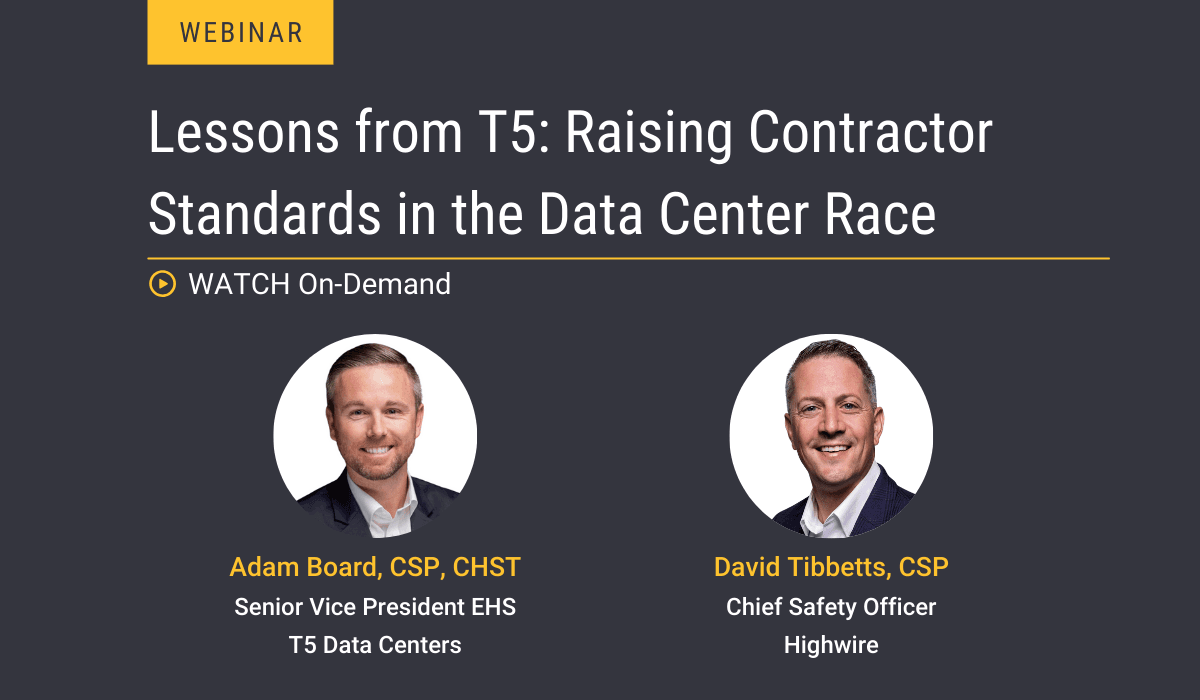
What does it take to manage contractors safely and effectively in mission-critical construction? David Tibbetts and Adam Board, Senior Vice President of EHS at T5 Data Centers, break it down in this episode.
Adam shares how T5’s unique role as developer, builder, and operator shapes their safety culture, and why leadership visibility and trust are non-negotiables. The conversation explores the challenges of labor shortages, onboarding new workers, and partnering with contractors who may be new to data center work.
Whether you’re a GC, trade contractor, or owner, this episode offers practical insights on how to strengthen safety culture while meeting the demands of a rapidly expanding industry.
Meet the Guest

Adam Board, CSP, CHST
EverOn Data Center Services, Senior Vice President, EHS
Adam Board is a Certified Safety Professional and Construction Health and Safety Technician, serving as Senior Vice President of EHS at T5 Data Centers. He leads safety strategy across development, construction, and operations to reduce risk and foster a culture of safety excellence.
Related Resources

Transcript
[00:01:14] David Tibbetts: Let's get going. Thank you again for joining us today. Just want to introduce myself first. My name is David Tibbetts. I'm the Chief Safety Officer at Highwire.
I'm really happy to have Adam Board, the Senior Vice President of EHS at T5 Data Centers, joining me today. Adam, thanks for uh, participating.
[00:01:33] Adam Board: Yeah, absolutely, David. Appreciate the invite here. Look forward to the conversation and sharing some insights and valuable knowledge as we talk safety across the data center industry.
[00:01:42] David Tibbetts: Yeah, that's great. If you could tell us a little bit about your role at T5, how you ended up there, and maybe talk a little bit about some of the work you guys have going on today.
[00:01:52] Adam Board: Yeah, absolutely. So, T5 data centers we're ultimately believed to be the most unique data center company in the world currently. We operate three different businesses under one umbrella. We're developer owner. We're a general contractor and we're also a backend operator, so we really have a turnkey solution.
And, really being able to offer that over to our data center clients is a real big value add for us at the data center market. For me, I've been with T5 a year. T5 continues to grow rapidly.
So I have the privilege to oversee all aspects of environmental health and safety across the company. That includes the development owner group, general contracting, and operating groups across North America and Europe. T5 is roughly over, 500 plus people. We continue to grow pretty rapidly with a lot of unique and different challenges, and we're operating three different businesses under one umbrella, but we're looking at continuing our growth in the data center market.
[00:02:49] David Tibbetts: Yeah, it's really interesting to hear you talk about the sort of three different hats that T5 wears, right?
Developer, owner, general contractor, and operator. So one of the things we're gonna talk a fair amount today is contractor management, and you cut across all those different aspects of it. You're interacting with and managing contractors as a general contractor.
When the facilities are operational, you then have contractors supporting you, maintaining those. So I just think it's gonna be really interesting to hear your perspective about the different approaches to how you interact with contractors.
It's been really cool seeing the growth, Adam of T5, but talk a little bit about the safety culture that's growing at T5, because I see you guys are hiring a lot of safety professionals across the country. What's that been like? Just building up the safety culture, building up the safety team, the type of support that you're getting for leadership, things like that.
[00:03:42] Adam Board: When I started at T5, we had a small group of safety professionals that really covered the operational side of our business, which has been intact for years now. I was really challenged by my manager to really build out a full department to be able to scale and grow with the business.
At that point, we had two or three mega projects, some of the biggest in our company history. So I had to really start hiring quickly. Going back to the culture piece of it, T5's been around for 18 years.
That kind of culture that they've instilled from 18 years ago is really trickled down, right? Obviously, we've got challenges as we continue to grow to maintain that culture, but our CEO talks a lot about having a magnetic culture. And with that is just. I look at it as just care for people, right?
Caring for those that work with you, besides you, around you. And that's not even including our T5 people, but our trade partners, our partners, because in the world of the data center, we're all partners. We all collaborate, and we all gotta look after each other. But it's really a magnetic culture that's been instilled and is maintained at T5.
There aren't a lot of companies, actually, there's no other company out there that, that could provide what T5 does.
And I think that's been a big selling point, obviously, tying in the culture. The buy-in and support. I wouldn't have come over to T5 if I didn't feel like we've got leadership support starting from the CEO all the way down to the COO. It's very evident and that leadership buys into what it is that we're doing.
They talk about it, they preach it. Because there's no company out there that says, Hey, safety's not first. Or, they have a slogan. But the real thing I see is, is leadership visible in the field? Is leadership saying and doing the right things?
Are they actually talking to their employees? Are they actually building trust? Trust is one of those things that, without it. Nothing else matters because you can't really build a great culture, a world-class culture, without trust of your employees. That's buying into what it is that you're trying to sell.
And ultimately, my job is working with the leadership team, and really, how do we influence, how do we get our leadership team visible in the field? How do we maintain that visibility across our organization? So how do you, A big piece is how do you maintain that culture as you continue to grow rapidly? Is what we're doing. And, we're gonna get there. I'm optimistic about it. But very excited about what's ahead for T5.
[00:06:03] David Tibbetts: Certainly sounds like a really exciting place to work. And I heard you say a bunch of things there that lead me to believe that leadership truly cares, and they walk the walk as well.
Let's talk a little bit about data center construction. Obviously, it's a hugely growing industry. It's very fast-paced. There's a lot of demand. What are some of the unique challenges that you see that are posed by data center construction that might not be as prevalent in some other industry segments?
What are some of the unique challenges that you guys have to face on a project-to-project basis or day-to-day basis?
[00:06:36] Adam Board: I get this a lot around, what makes the data center market unique, and the industry what's different? A couple things come to mind.
I think the data center industry, ultimately, we work for some very sophisticated owners that are very stringent when it relates to environmental health and safety. Now I look at that as an opportunity and a driving factor to grow and get better. Because we've all worked for owners that really don't care.
They don't really have a hand in safety. I think that's one of the big unique challenges with is, the data center market is so busy. All of your big hyperscale customers are building all over the place. For the most part, they have a lot of consistencies, but they have a lot of differences.
So, as a general contractor, as an operator, when you're working for multiple different clients and users, you're having to navigate the differences in programs and expectations. Your program is not gonna be a one-stop shop. You're gonna have to be able to navigate with one hyperscaler or a client has, and there's some unique challenges with that as it relates to just making sure, and you really having to ever change your program to adjust to best practices and what the client needs are. So that makes some unique challenges and opportunities regardless. The other thing in the data center market that I think is unique is, one, the labor shortage, everyone talks about it, right?
It is extremely real, right? Because everyone's fighting after the same people. And you're starting to see this fresh breed of people who just didn't grow up in construction, who don't have the experience and knowledge of the past five, 10 years ago.
Most of the people that were in construction either have grown up in construction, their background's in construction, their families are in construction. They understand the unique risk and the hazards that are associated with construction. And construction, it takes time to adjust to what it is.
Because there's so much high-risk activity and scope and risk on a construction site, that people who have not been in that world are having to adjust. And so for us it goes back to having, how do we onboard and help contractors and these new people be successful on these projects, because.
Everyone's still got demands. They have schedule crunches. We have to hit; we have these end dates, but at the end of the day, you can't get there without people. That's the big thing. So how do you build people up? How do you integrate? How do you build foreman-level training? How do you build new hire training?
So those, to me, would be some of the unique challenges that are being faced right now in the data center market that. I think anyone in the data center, in the industry, is faced with. T5's not the only one. And I think it's gonna only continue to become, stay challenged as we continue to build, and the demand continues to grow.
[00:09:23] David Tibbetts: I wanna follow up on a couple of the key points you made there. You mentioned that you work for sophisticated owners, and those sophisticated owners they have certain expectations of T5, right? What it means to work on their sites, and how they want the work to be delivered.
Certainly. Some specific aspects as it relates to safety, but I think you probably look at that, and I've always looked at it, even back to my days, on the asset owner side, where we had some pretty unique requirements. I think when you create an atmosphere of partnership, or maybe from your perspective as well, when you work with those clients, yes, they have some demands.
Maybe there's some things that you wouldn't normally do on your own sites. Maybe they are, but it's an opportunity to learn, too. I'm sure that you take away from some of those experiences, things that you want to incorporate into your own processes, right? You get some best practices, you get some lessons learned.
It's a great way to collaborate and continue to grow your own safety program, right?
[00:10:18] Adam Board: I 100% agree with you. Over my years as coming from a general contractor to an owner to T5. The programs I've built. The taking and using, that's the easy part. It's the implementation that's the challenge.
So I've taken best practices that I've seen over the years, which, to be honest, a lot of that has come from my experience in the data center market. A lot of the GCs are these owners; they really challenge you to really think outside the box and come up with the best-in-class programs.
And the good thing about safety is. You can steal and, update, and use as you see fit. But that's the easy part, to get a GC to send over a program. It's how to, how do you modify it, how do you fit it to your own program, and how do you get people to buy into it?
So exactly what you said. These hyperscalers, they're sophisticated. They have really high demands, but. You're also seeing some of the best world-class programs and things that are really outside of the box thinking as it relates to safety because they're challenging general contractors and subcontractors to really think differently.
And I just continue to love to see, and if someone comes up with something. I'm happy to grab that and see how it fits into T5. That's how I built all of my programs and safety. Most of the time, you're not reinventing anything; you're really just taking it. So there's a lot of benefit to that side, and even though the challenge of the demand is high, I mean it, there's really so much good that comes out of that because the owners are really challenging people to think outside the box and come up with new innovative solutions.
[00:11:53] David Tibbetts: You touched on labor shortage as well. I think it's really important. It's not just a concept; it's not just something you hear. And I wanna just comment on the fact that there are some significant safety risks that come along with new workers, right?
New workers to the industry. Obviously, safety is critical in that. Obviously, the quality of the work could potentially suffer as well, which increases the safety risk if that work needs to be redone again. So I really like that, you mentioned that it is a real challenge. It's not just a theory or a philosophy.
It's really important to understand how are we gonna onboard these workers? How are we gonna pair them with experienced workers so that they can learn from all of that knowledge that those folks have gained over the years? 'Cause it's really difficult to get to a place where you're comfortable out on a construction site where it's so busy, it's so active, everything is moving so quickly around you, and these new workers need to.
To that place as quickly as they can, where they are able to recognize risks and make the right decisions, 'cause they're not gonna always have somebody side by side with them. So it's incredibly important, and I'm glad we touched on that. I wanna just shift to the topic of contractor management.
You've talked a lot about partnerships. You've talked a lot about being successful together. The term contractor management might have a certain tone about it, but what does contractor management mean to you? Or maybe how do you think of it in different terms?
[00:13:18] Adam Board: When I think of contractor management, I think of.
Kind of the life cycle of, start to finish of, working with contractors. In today's market, right? If you've got a contractor in a particular area that does good work for you, usually you're gonna try to maintain those relationships. So I look at it as a long-term future partnership and plan, so for contractor management, I look at it from a prequalification standpoint.
Lifecycle of a project. And then the end. And, my job is to really, or at least our job, I feel like, is to have frequent touchpoints and help contractors be successful from the very beginning. Like utilizing our prequalification process, right? That's just, we look at lagging data, we look at programs, that doesn't mean that we can't use a contractor that may not be flagged in certain areas.
Our goal is to, hey, help them get to a place to where they have at least the minimum requirements to be on our project site, and then help them along the way, right? You can't hold hands, and you gotta have some, you gotta put some accountability back on the contractor. But at the end of the day, I feel like the success of contractors is a direct reflection of the success of, looking at us as a general contractor.
Because you win together, you lose together. I'm a firm believer because if the electrical contractor, the mechanical, if they struggle and they struggle. It doesn't matter if they're hurting people constantly. You've gotta help them, like you gotta challenge them, but to help them get to the next phase, because if they're not successful, we're not successful.
Because it doesn't matter about, schedule and quality. If we're hurting people, if we're not doing the right things in safety, it's not a success. To me, it's the full life cycle. It's. It's starting from the very beginning and ensuring frequent touchpoints along the way.
And when you see someone struggling, I think it's easy. It's the easy button is to just beat up on 'em and say, Hey, you know you're struggling. You suck. They may not know, like they may not know what to do. So help guide them and give them some opportunities or solutions, or, Hey, this is what we've seen in the past.
This is what we think could work. You may have seen it, but if there was this one, one-page document that said, Hey, do this and you're gonna be successful on every single job. Every job is unique. Every opportunity is unique; the risks are different. It's gonna take a team approach.
So when I think of contractor management, like I said, I think from the beginning to the very end, I think through a life cycle of a project and future partnerships down the road, and just having frequent touch points to ensure that these contractors are successful along the way.
[00:15:53] David Tibbetts: I love that you mentioned touch points a bunch of times there, because when you think about Contractor Management. Maybe some people think about prequalification as Hey, that's a really important step. We're gonna pre-qualify this contractor, are they good enough or are they not? Do they pass or do they fail? And it might stop. Stop there, right?
I think that there are opportunities to share feedback during those touch points at all of those different phases. At the prequalification phase, as there's not an infinite number of contractors, right? You might identify that the risk is too great for some small subset, and maybe you're, you're gonna find somebody else. But for the most part, these are the contractors that are available to work with us. Some of them present risk, some of 'em might not meet our minimum expectation right off the bat. Some of them might be flagged for whatever reason, but that's an opportunity to have a touchpoint.
That's an opportunity to talk to them about what the data is telling you. Hey, here are some risks that I see. Let's talk about how we can make sure that these risks are addressed and you're successful on this project. And then once they get on the project and you start to engage with them, and whether it's planning exercises or foreman's meetings or conducting inspections out in the field, you gotta continue to use those opportunities to share.
Share what you're seeing. If you're seeing an emerging risk, talk to them about it. Talk about how you can correct it. What are some things that we could do to address that risk on that project? And then, when the project finishes, sit down with them and talk about how they did. What did they do well? What are some opportunities for improvement on the next project?
And one thing that I firmly believe is that type of engagement and collaboration, and sharing of feedback. Throughout the course of any project will help that contractor become better because, just like maybe you learn some things from the sophisticated owners that you are working with, maybe you helped that trade partner think about a different way to do something, or maybe a slightly better way to do something, and maybe they incorporate it into their business.
And they become a safer performing company. Over time, you have strengthened your relationship with that contractor. You continue to build your pool of available contractors. And in a lot of ways, you just, it's important to maintain those relationships. And you have an opportunity to help these companies become better by being a good partner.
[00:18:06] Adam Board: Yeah, agreed. I think, in the sense of the data center market and how busy everyone is. And another thing is, you're not always going to get the primary contractors. You might have to get someone that's not been in the data center market, or you may get someone that's a smaller contractor that is subbed out under a primary, and they still matter. I'm just a big believer in it's a one team approach and, utilizing each other's experiences, especially in environmental health and safety, and helping people get better.
Because I agree with you, I've taken a lot of best practices from others, and our goal is to really help these contractors. And like you said, I always look at it as a benefit if, an EC or a mechanical. We came up with something that was a really cool system or process through a project, and they made it a company policy.
I feel like we're doing something right. And one of the other bigger things around contractor management is getting the leadership of contractors to buy in. It's one thing as a general contractor, we have our minimums, you can push out the best programs and help.
That leadership contractor management has got to be involved, and they've gotta be visible and they've gotta set the tone because they own their scope. I'm talking from a GC lens, but the leadership buy-in from the subs is really just as critical, and that's really gonna set them up for success along the way.
If you've got a superintendent or a project manager, or you don't set the project up from a funding standpoint, and you know you don't want to do X, Y, and Z, it's gonna be really hard for that contractor safety rep to make any impact or change. Again, it goes into leadership buy-in from all aspects and all levels, but that to me is really a good partnership along the way from a contractor management standpoint.
[00:19:50] David Tibbetts: You brought up something really important there. Most of our interactions with a contractor might tend to be with the frontline supervisor or with the project manager for that specific project, right? And those interactions are really important, especially at the project level, to make sure that the project is on track.
But you gotta also think about the opportunities to bring in leadership from those companies or have discussions with leadership from those companies. What have you seen across projects working with this contractor? What's going well? What do we think are some opportunities for improvement? When we think about the prequalification phase, if there are some risks that are a concern, whom do you have those conversations with?
Do you just have 'em with the project manager, or are you maybe bringing in members of their executive team or their leadership to say, Hey. We value our partnership. We know you're available and capable of doing this work, and we're considering awarding you, but here are some things we want to talk about.
Do you know what this data tells us as T5, how should they be thinking about some of their data and how it's viewed, or how they could turn around some of their trends and things like that. So I think it's important to think about that too, because you could get caught up in the day-to-day having the interactions with frontline supervision and people on site, and that's important, but also, how are you interacting with leadership? Understanding what their level of commitment is to safety may be driving them to implement some new processes or best practices. So that's a really important aspect of it.
You touched on something else in your answer there, around contractors who maybe don't have a lot of data center experience today. It's a booming industry. There's so much work out there. Surely there are contractors who haven't worked in data centers before. Maybe they've worked in some other advanced manufacturing environments before.
Maybe they have worked on some fairly complex projects before. But they've never done data center work. How do you guys think about that? Would you consider a contractor who never worked in a data center before? If you would how would you approach them? And what advice might you give to contractors who are trying to break into the data center world, and some advice for breaking in, but also how they could be successful doing that type of work?
[00:22:01] Adam Board: When I look at contractors that may not have a ton of experience. Again, I would say, I would love to say that every contractor that we bring on board is, has tons of data center experience. But another challenge we have is we're all fighting over the same trade partners.
All the ECs, all the MEP trades, the drywall companies, and those that have been in the market are in here, and they're pretty busy. So for us, when you're building projects, you're also not having the luxury all the time to build in these big cities or areas or metros that all the main trades are having.
For us, it's okay. We have a project in the middle of, random country area where. You may not get a lot of contractors that bid, and you may have to go with a local trade or a contractor that's the only EC in that area, or the only drywall company, or the only roofing company. And when I look at that, I look at that as, again, would I like to have a primary, especially on the mechanical, electrical, like the MEP side of it, of course.
But I know that's not always the case. And for my side, it's. Okay. We know we're going into this project. We're gonna have to use some local trade partners. They don't have any data center experience. Okay. The numbers, here's some things that were flagged in their program. Okay, we need to meet with this team.
Let's have an initial touchpoint. Are you committed to this best-in-class world? And that's really bringing in their leadership and their ownership and really talking through and saying, Hey. Because it's not, you don't wanna sign someone up for someone to not be successful.
So I think it's really setting the tone early, so when it goes back to those touch points, so it's, Hey, because safety like data center, it's not like the expectations are higher. I think the programs are a little bit more mature. And they're maturing.
You are held accountable a little bit more due to, just the nature of the clients we work for. But that touch point initially, early in getting buy-in from the team, meet with them for a pre-installation kickoff meeting. Reviewing in detail their program versus our program to ensure that they match and that we can help them.
And then also making sure that they have the right staffing, right? If it's an EHS person and has some good experience in the data center market, or needs to, that definitely has some safety experience, just helping them along the way. Again, we're going through that now. And we've had some success stories, right?
People, I think some contractors really take advantage of the opportunity, and they're like, Hey, I will do whatever. I will listen. So I think if I'm speaking to new contractors, it's one, have an open mind, be able to listen, be able to pivot because you may be, you're probably gonna be challenged in ways in safety that you haven't been in this market.
Be flexible. And also, be sure to hold yourselves accountable and just say. Hey, I don't know. Can you help? That's a big thing. Can you help me? Or, we've looked at this, and this. What do you think? So I think if you have an open mind, you've got the right leadership, engagement, and buy-in, and you're just, you're able to pivot and adapt to a new industry and expectations, we can help you along the way. So again, it's not that. People can't do it. It's just, people go in and think, Hey, I'm just gonna do it the same way I've been doing these commercial builds down the road.
And, that's really not, that's a very tough transition, and it's really not gonna work. So that's just some things that I would suggest to new contractors, and just also helping 'em along the way if they don't have any data center experience.
[00:25:26] David Tibbetts: One of the things you said there is you gotta go into it with an open mind. You gotta be willing to learn, right? You've gotta be willing to partner, you've gotta be willing to recognize that, hey, this might be different than something we've done before. You talked about a lot of the conversations and touchpoints that you would have with a contractor like that, and I think that sounds to me like throughout those conversations you start to get a sense of how willing that company is to partner with you, to be a good partner to learn, but also to get a sense of what kind of level of commitment to safety does this company have.
Granted, they might not have worked in data centers in the past, but how committed are they? What does their safety culture feel like? Does their leadership say the right thing?
Those things are important too. So contractors shouldn't be afraid of moving into the data center world, but they should also be prepared to partner, to learn, and maybe to be asked some critical questions about their company's culture, their company's organization, and their ability to deliver on that type of work. So thank you for sharing that.
Before we wrap up, we've talked a lot about contractor management throughout the lifecycle of a relationship with a contractor. In a couple of different roles you've had, you've used Highwire to help support that. If you could tell us a little bit about some of your favorite features in Highwire or some of the things in Highwire that really help you facilitate those important conversations and understanding the level of risk that a contractor might present to you if you bring them onto your project?
[00:26:55] Adam Board: Yeah, absolutely. There's many of things, at least in my perspective.
What I like about Highwire, and again, there's a ton of different programs out there, and I know a lot of 'em have a lot of similarities. But when I think about the whole life cycle of Highwire, what I love about it. One, from the very beginning from the prequalification process, Highwire makes the understanding of prequal information, especially in the safety lens, very user-friendly and easy to digest, right?
They do a scoring system. It goes back to grade school, and anything greater than an 80 looks good. Anything less than that could be flagged. So I think from a lens standpoint, just making it very easy to understand, not just from a safety standpoint, but when sharing that data with our leadership team, of, oh, okay, obviously they don't have a hundred, so they're missing X, Y, and Z.
And having it into one system that really looks at their programs and all of the lagging data. 'Cause before then, for years I was doing hard copy paper, and you're reviewing it, you're putting it into a file, and guess what, that's never seen again. So I think the pre-qual and just making it easy and having it, the scoring system, to me, that's extremely beneficial.
The ability to flag things that we set up from a company standard like that also allows us to, we're not having to review every contractor, but the ability to flag, hey, if you don't have a full-time safety rep, or if your program's missing certain key elements that we're looking for at T5. It flags 'em, and it allows us to go back and have a discussion with the trade partner. That, to me, is super critical. And then you move into the inspect tool. The inspect tool, again, used a ton in my career. I always look for user, in user access, and how easy it is for a foreman or a project manager to use it, because anything that's complicated with too many buttons.
People just don't use it. Doesn't matter how much money you spend, they just won't use it. So, just the ease of the system from the mobile app to the desktop. And then the data and the dashboard on the desktop, just to be able to kind of see it real time, is very beneficial to us. We use it every week. We look at the data, we send out a follow-up report of the trending, and we allow our teams to focus on those various topics, but. I just love the ability, the easiness of the app and the desktop, and just getting data into the system, and then also the desktop too, that that correlates all the data and allows us to put action to the data.
Obviously, there's some other features that have come with the inspect tool that have been beneficial over the last, I think month, maybe. You all wrote out some additional enhancements to your inspection. We've set goals for our team, right? And you could see that real time in the inspect tool, which I love.
We set expectations, we set goals, and we can also see real time of who's meeting those goals and hold them accountable. I love that feature as well. Then on the back end, the incident tracker piece just to be able to correlate and manage all of your incident data into one, one house.
Is good for us at T5. Again, it's a work in progress because we're still slowly rolling all of that into but at the end of the day, the greatest benefit to me is a lot of these trade partners we work with, we work for on various other projects, and we're probably gonna use them. The cool thing about Highwire is that all of that data houses into their profiles.
So that when you're looking at a bid on a new project or down the road in six, eight months, you can bring in the EC or the drywall company, and you can look, Hey, by the way, you know you had 25 high-risk fall protection issues. You also had three recordables across our portfolio last quarter.
That's not gonna be acceptable. So by the way, we're gonna need a corrective action plan before you can even bid this job. Because think about it, and in the lens of contractors, the projects move so quickly, the data gets lost after the project's done, the information's gone. And you know that EC, that just struggled in your project in California, by the way, they're bidding your job in Atlanta. You don't have any data that can go back and showcase that. And by the way, that team member that ran that job, they left too. So you don't know anything for the project. So for me, it's just all of that information, housing into one system.
Being able to utilize that from an early standpoint through the life cycle of a project, but then also having the benefit to have that data housed and use it for future. Is just extremely beneficial and critical for us, and I think it's gonna be a critical piece to our success as we continue to build these trade partner relationships down the road.
[00:31:31] David Tibbetts: Thank you for sharing all of that, Adam. I really believe that, as a safety professional who's been out in the field, working with contractors before, that data that you aggregate over time from project to project is really valuable. It can't get lost. And when you can put side by side a contractor's sort of prequalification assessment, but also look at their performance, how have they actually performed on your projects?
As you have all of that data together, it lets you make an even better decision on the next project. And it also informs your approach to. Hey, do we need a corrective action plan for these guys? It also informs a pre-construction meeting, whereas instead of having a more general discussion, let's talk about the things that we saw on the past three projects, and let's figure out how are we gonna do better on this project?
What are some things we can do from a planning perspective, from a training perspective, from a monitoring perspective? What can we do to do better on the next job? It's about being successful together. It's raising the bar, and that's the mindset that really drives everything that we do.
So we're gonna wrap it up here. One thing that I wanna mention that I love about the data center industry specifically, and we have quite a few clients in the data center space, and I get to work with exceptional safety professionals like Adam from those companies. And there's just such a desire to collaborate.
Now, you said that in a lot of cases you're all fighting for the same contractors, and that's true, but there's this really strong desire to come together as an industry, a data center industry, from the folks that are building them, whether those are GCs. To the owners of them or the developers.
We are really feeling the strong desire to collaborate. And I love that. I want to thank you, Adam. Any parting thoughts that you wanna share before we wrap it up?
[00:33:19] Adam Board: No. Other than just, I appreciate the time today to dive into just safety, knowledge, and things that are happening in a very busy, rapidly growing industry. And again, I'm all about partnership, collaboration, and helping others. And, for those that have questions, feel free to reach out.
Safety's not one of those secrets, so I'm happy to share anything that we're doing that's been helping us over here at T5.
[00:33:43] David Tibbetts: That's great. That's what we do in the industry: we share. Again, thank you, Adam. I really appreciate it.
Hope you all enjoyed our session, and reach out if you have any questions or comments.