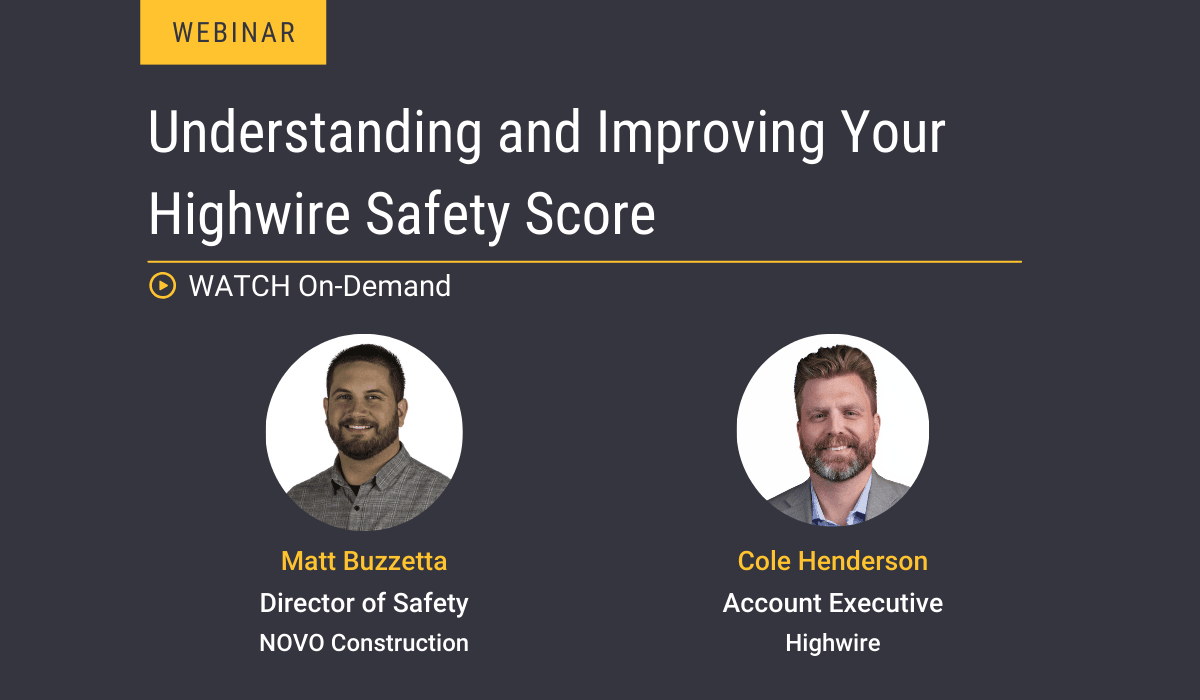
How NOVO Construction Evaluates Subcontractor Risk
Join Matt Buzzetta, Safety Director at NOVO Construction, for a behind-the-scenes look at how one of the Bay Area’s leading GCs uses Highwire to understand subcontractor risk and build a stronger safety culture.
Matt shares a unique perspective as both a Highwire contractor and hiring client, offering insights into how Safety Scores are evaluated by safety and prequalification teams. You’ll learn how NOVO uses both lagging and leading indicators to make informed decisions, and how they are working with their subs to improve safety outcomes across their projects.
Meet the Guest

Matt Buzzetta, STSC, CHST, CRIS
NOVO Construction, Director of Safety
Matt Buzzetta is the Safety Director at NOVO Construction, the largest tenant improvement general contractor in the Bay Area, specializing in technology, professional services, and life sciences sectors. He brings over 15 years of combined safety experience in the Construction, General Industry, Environmental, Public and Emergency Medical Service fields. Matt’s expertise lies in implementing proactive safety measures and developing comprehensive training programs. His leadership has been crucial in establishing a culture of safety that minimizes workplace risks and incidents.
Related Resources

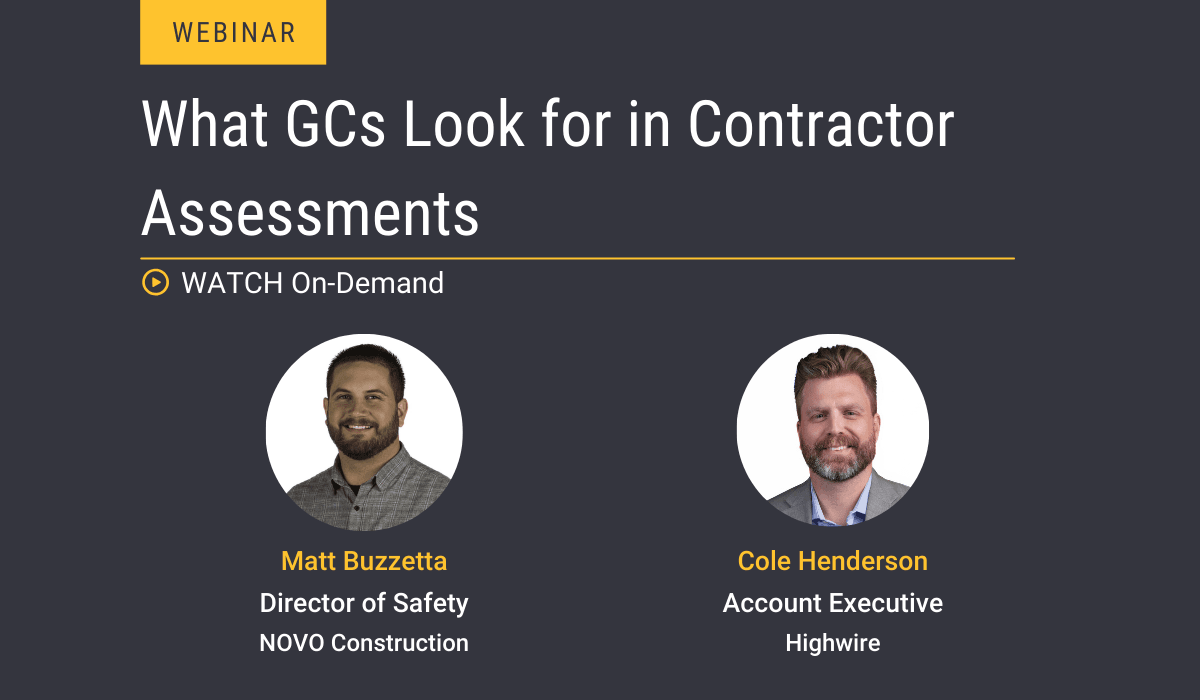
Transcript
[00:00:59] Cole: Thank you so much, everybody, for joining. We're very excited to have you all here. I am Cole Henderson. I'm an account executive here at Highwire. Previously to Highwire, I spent 10 years in the United States Army, another 10 years or so in software, and been spent the last two years working with both clients and potential clients on using Highwire to help understand and mitigate risk in construction.
I'm joined by Matt Buzzetta from NOVO Construction, and because I wouldn't be able to do justice to an introduction, I'm gonna hand it over to him to talk about his own introduction, his own safety background. Matt, go ahead.
[00:01:34] Matt: Appreciate it, Cole. Hello everyone. My name is Matt Buzzetta, Safety Director with NOVO Construction.
My experience spans over 15 years in the construction industry, including manufacturing general public as a firefighter, EMT, and the construction industry. Approximately eight years ago is when I joined NOVO. NOVO is the largest tenant improvement general contractor in the Bay Area, serving the San Francisco and Texas area with 325 employees.
We're headquartered in Menlo Park, with offices in San Francisco and Austin, Texas. 80% of our work is from repeat customers across technology and professional services, and life science sectors. Types of projects delivered include office interiors, R&D labs, manufacturing facilities, site work, and infrastructure upgrades.
I myself, as part of a team of safety professionals here at NOVO, we're known for our commitment to safety. Elbow has been recognized as an industry leader in safety best practices, including receiving Highwire itself platinum Safety Award, Highwire’s highest award. So excited to do this webinar with all of you and share a little bit about my experience with the Highwire system.
[00:02:54] Cole: Can you talk a little bit how you first started working with Highwire and how that came to be?
[00:02:59] Matt: We started with Highwire approximately eight years ago when a well-known barrier client asked us to join as part of their requirement for the construction side of it.
So since then, we've met these high standards of Highwire and have maintained our contractor account like many of you on this webinar also. Over the years, we have saw the many benefits and advancements of the Highwire system, not only as a contractor, but also as a hiring client, working with our client to qualify and assess our subcontractors.
We then decided to use the Highwire systems ourself and now require all of our subcontractors to complete the Highwire assessment and maintain a profile. To understand their risks and work together on those
[00:03:50] Cole: Quite an extensive background. Again, you have a unique perspective, which is one of the reasons why we're excited to do this with you.
As you've seen both sides, right? As a contractor yourself, and now, assessing the subcontractors on your own. Let's go ahead and jump right into it.
We're here really to learn what contractors like NOVO are looking for when assessing a subcontractor, how they interact with subcontractors, and the platform to understand and mitigate this risk.
And along the way, hopefully, we'll learn a little bit more about this contractor assessment process and dispel some myths. So here, pretty quickly, you're gonna get another pop-up asking about how confident are you in what actually happens with your assessment after it's submitted.
Let's start by kinda setting the stage. And I'm gonna share my screen. Some of you guys are already familiar with what it actually looks like on the other side of Highwire within your own product profile. You have your own information.
You house this here in Highwire. What we're here to talk about today is this other side and what actually is done with that information. What does somebody like NOVO see?
What are they looking for in those different areas? I'm gonna navigate over here to this dashboard or homepage, and what we're really getting a sense is this is where somebody like Matt would come to just see how many of these subcontractors are connected and sharing their information. First question I asked you, Matt, somebody comes in, you got a new company you're working with, what's the first thing you actually look for when or preparing to evaluate them?
[00:05:10] Matt: So yeah, once a new company comes in, does their assessment, the first thing that we're gonna be looking for is if they have a safety score populated. And along with that is if there's any flags, the system will generate the flags and generate that score. And that is what we're looking for.
[00:05:28] Cole: Got it. So I'm doing the driving as Matt's kind of talking and navigating here, from this homepage, I was clicking on just a few folks that didn't have a complete safety score, and I can easily see they're missing some component of it. You could click on the company itself and request completion or follow up because without that score, there's really no place for them to go.
One of the things that we talk about dispelling some of these myths, and the first one that I know you and I have talked about this before, Matt, is if I have a low score, I'm automatically gonna be disqualified. Can you talk a little bit more about stories you've had, have heard, or some other context for information like that?
[00:06:03] Matt: Some of it with the safety scores again, I I advise our our subcontractors and new companies into the Highwire system is, don't be afraid of it. Use it as an assessment tool for yourself. We've had many experiences with subcontractors. That one in itself, I can say that use the Highwire system generated a low score.
But what we remind everyone is scores are not permanent. Scores can change. Use Highwire as an assessment of your company, your safety standards, your history of safety within the company, and identify those weaknesses. Identify what we can do better. We work with our subcontractors to do that and are very successful with the Highwire system.
[00:06:48] Cole: One of the ways that I've found helpful to think about the safety score is thinking almost like a credit score. It's just helping you know where you're at in a point in time. You can go up or down. I know you and I have talked about this before; it doesn't have to be something that defines you.
It just lets you know where you stand, and then you can do something about it. It brings me to the next question about the score itself. It's probably a good time for me to talk a little bit about what that score means before we dive into that. The score is essentially created back Harvard University several years ago, over 15 now, by the folks on the construction side. Just trying to figure out where were the, where was the different risks being presented by the different subcontractors coming on site to build projects.
And really, what it is, is just a combination of different inputs with both lagging and leading indicators that put together this score, which is a just an initial indicator of risk. And as you've alluded to, Matt, it doesn't necessarily mean that you're in or you're out. It just lets you know where you stand at that point in time, and then you can understand where those different risks that you might wanna dive into.
So let me ask from your perspective, how does NOVO actually use the safety score?
[00:07:51] Matt: Yeah, so we assess the safety score out of a hundred. As you can see on the screen, it defines each one of those as a identifying for a number, a score to each one of those aspects. EMR, dart, recordable cases, fatalities, OSHA experience, and then getting into safety programs.
Safety score overall is generated from that. It's very important, but it's not permanent. This is to identify and assess your company. For us as a general contractor to assess your company to items that can be improved or those strengths that we need to capitalize on and continue to do that is what we look at with the safety score. It's a quick way for us to understand each contractor and where they can improve. We categorize our safety scores from subcontractors into tiers. Each one of those tiers is a different requirement depending on what that score is.
But again, there is always room for improvement. Then at that point, we work together.
[00:08:53] Cole: So I have a appreciate you sharing that context for how you guys use that. I got a live question I wanna help answer as far as how often does this get updated and how long does it take for that assessment to actually be updated in the system?
When you first enter into the system, it's the first time, and then that information is updated annually. Once you're complete with all that information, it's one of the first things Matt's looking for to make sure it's complete. It could be within a matter of minutes.
[00:09:17] Matt: There's a QA/QC process internally on our side that goes through. At most, it'll take 24 hours, but as Matt knows, we've worked together, he's actually messaged us and our team and said, Hey, I really need to get these guys on site. Can you go ahead and push this through? We're able to coordinate with the Highwire team and have that done in a matter of minutes, and that is one thing, Cole, that I wanted to say to you with this is Highwire. It is not just a computer system, and no one is there on the human side to help with this. They have a team. Not only we work with the team as a general contractor, as a hiring partner, but yourself as a contractor using this system and getting assessed by it as a team of Highwire professionals that can.
Work with you on that. So again, score's not permanent. Use it as an assessment tool. Get in there, identify those items, and improve.
[00:10:07] Cole: And that's why we exist. We're always here for that, anywhere in the help icon. We've got plenty of folks listed here for you to reach out to. We actually love answering those questions. We're actually based, I'm right outside the office from a lot of those folks right now. With the door closed, as I'm sure they're talking to a lot of folks.
So we talked a little bit about the score. Can you talk to me about a situation where a contractor might have started out with a low score, but when you worked together, they ended up being really successful?
[00:10:33] Matt: Yes. So we have an internal view of the score and tiers. We look at different automatic approvals scores above an 80, no flags scores between 70 79 with a corrective action plan in place, and conversations on that. And then scores below 70 requires a little bit more of effort from the contractor and commitment on that side that we work with to see again, [00:11:00] assessing their score and the needs and weaknesses that.
need to be addressed. We had a subcontractor partner that normally maintained a very high Highwire score, and unfortunately, had an injury that considerably increased their EMR and DART and resulted in a decreased Highwire score. We were able to identify that and work with our subcontractor.
And following our commitment to safety, we worked with the subcontractor to identify those weaknesses and formed a corrective action plan jointly. And with their commitment to safety, the subcontractor was able to increase that score.
It's not permanent. Use it as an assessment. To identify all aspects of safety within your company, including your program, lagging and leading indicators and can be very successful for you if you're using it. Another situation I've had. With a subcontractor, we invited the subcontractor to enter into Highwire, be assessed, use the program, maintain an account.
They found themselves with a very low safety score. Don't be afraid of a low score. Identify it, embrace it, and address it.
We worked together with them. I. And found discrepancies again with Highwire in ourselves. And the subcontractor found some discrepancies in their assessment where they may have answered the questions. An example would be in the assessment side, answered a question. No. But it did actually pertain to something that was.
Supposed to be answered. Yes. So, like in management systems, there's many questions having to do with their program, what programs they have. And how it is gonna be enforced in their company. So an example would be, have a crisis management or emergency action plan, if you mistakenly answer no on that questionalthough we know you do have a crisis management plan, emergency action plan that is being enacted.
It is written, your employees are trained on, and it is being enforced. But answering no. Will result in a decreased score. So, identifying that, going back and immediately changing that question to yes, we'll immediately raise that score. And in fact, increased the score so much that it gave them a passing, automatic approval type score.
So those are some of the examples that I can give, and being successful with Highwire in identifying those.
[00:13:27] Cole: And to your point, it's that the next myth we talk about is that your score is static and that's all it's ever gonna be. The examples you're giving not necessarily waiting for it to change.
Once your metrics change the next year and you get your new OSHA data, but what can you actually change immediately? And I think that's the point in working with clients such as you, looking for in the score is where you can make those immediate changes, where you can make those improvements.
As we look to make those improvements, we do the same thing that you guys are doing. Try to act more like consultants to help understand where they could gain those points back. So we're working towards that same kind of goal.
[00:14:00] Cole: The question is, when you made it mandatory for trade partners to utilize the tool, did you have fallout from smaller trades that don't have the bandwidth to produce these documents or take the time to fill this out?
Matt, I don't know if you, as someone who's recently done this and transitioned from someone who was on the contractor side, maybe not necessarily on the smaller trade side, but now rotating into this, what's been your perspective or your feedback?
[00:14:23] Matt: So we haven't had a situation where it's made it where they cannot fill out the program or cannot perform their safety assessment. We have had a situation where a smaller company answered the assessment truthfully, which we ask everyone to in the sense of their programs.
It was identified that they didn't have many programs they should have for the type of work they performed. Working with Highwire to identify those, they actually worked on internally in their company with generating a safety program that can be compliant for their operations. Answering that assessment truthfully may result in self-reflection that your company may need to enact those programs that they were not doing.
So that would be some of the items. We haven't had an experience with a small company that didn't qualify because of that. But working with them to generate those programs to have a safe overall company is our goal.
[00:15:23] Cole: I know we we've talked about this and even alluded to this in today's meeting, but the as far as bandwidth, we understand that, sometimes, smaller companies only have a few folks providing this information.
[00:15:34] It's required, and that's again, why Highwire exists. We have teams standing by right now to answer questions if there's any sort of question about how to do something. We're here to do that, and I've done that for countless different contractors. Please reach out to us.
[00:15:47] We're here to help NOVO in that process, so you guys can focus on the business aspect while we focus on the functionality and helping people actually get it completed.
Cole: What kind of data is important to NOVO?
[00:16:00] Matt: So again, we look at the big picture, having that safety score printed right there. But looking at each one of these items, what the safety programs are actual recordables, OSHA citations. You see a number put on each one of these, but we have, as you do as a contractor or a hiring partner, you have access to each one of these. And we can dive deeper into this. So by getting into that recordable rate or that dart rate or that EMR, we get not only averages, but also can see past history.
With the company, we can identify a bad year. And then dive deeper into that based on that data. EMR again considered that gold standard, but it's only one aspect of the assessment. Which again, we have a great opportunity there to assess overall recordable rates don't always turn into a situation where it affects EMR, and again, that's where different things we wanna identify.
Like I said, recordable rate, dart, EMR, citations, it's all part of that score and data that is very important to us as a contractor. Looking at those lagging indicators.
[00:17:11] Cole: And so as I'm pulling this up, something you just said popped out to me, you talked about, hey, it looks like maybe it's just one bad year.
For the most part, it looks like most of the rates have been okay, but in this particular case, 2022 is all of a sudden had a little bit of a spike. This data obviously immediately tells you where to go and ask that question to somebody. You can get to the bottom of, was it a, maybe something about their practices, or just some sort of other thing that might've been outside of their control.
Is that generally true?
[00:17:37] Matt: That is, and the other side of that, too, is identifying what the company's response was. Unfortunately, an accident happened. And how did the company react? Is there identifying safety programs that needed to be updated, new training, what needed to be corrected to reduce or remove? Incidents from the equation here.
[00:18:03] Cole: Yeah. Like in a lot of things. Sometimes you can't prevent every bad thing from happening. It's how you react to that. The same is true in software, and same is true obviously in the construction industry. So what you've been talking about are the lagging indicators.
What about these leading indicators, these things that might indicate future performance? What aspects of a safety program do you guys specifically key in on?
Matt: Honestly, each one of them, we get right into management systems. We get an overall score. We get that first glance, but we look at each one of these items to identify what the company has answered and identify what.
The actual safety programs the company has. Another great thing about the Highwire system is answering these questions in the assessment. Marking that answer as a yes will require you to upload your safety program, which then, at that point. We can view that safety program, but also the system checks, and make sure that program is compliant with the assessment question that is answered.
So again, I would say we review all aspects of that. But having those safety programs, an example is, if your company does a lot of work with hands and not having a hand safety program or glove program, etc., those are different aspects that we can identify to make sure that. We identify those weaknesses and correct them.
[00:19:29] Cole: And you, you also mentioned something before, about a return to work policy, which I know is another yes or no, and how the answer to that, as you've articulated, can actually impact your dart rate when people are actually returning from industries.
Can you talk a little bit more about that?
[00:19:42] Matt: Part of it is that education side. Smaller companies might not have the bandwidth to review all the policies and procedures that are required, but that is part of it. This system will identify that, Hey, do you have a return to work program? Not having a return to work program is somewhat a direct side of the increased dart rate. And not getting employees back to work appropriately, and having that return to work program on that side.
[00:20:10] Cole: And you mentioned before about being able to look at this holistically, to summarize, looking at where the points were deducted or lost and how those could be earned back immediately, you talked about yes or no responses in some of these management system areas in addition to these points that have been deducted for the safety manual.
These are opportunities. Where you can, you can work together to earn these points back immediately. You don't have to wait for your EMR to recover years from now. These are points you can get back right now, and all of a sudden, that 65 is nearly an 80.
[00:20:39] Matt: So, looking at this, the assessment answered by this company will come up and identify each one of the sections that was answered. The system of Highwire is identifying that this company either did not upload their proper program for generating an answer of yes, or their program did not contain this clearly.
This is a benefit to every company that performs a safety assessment within Highwire Identify, where their program is lacking, and be able to generate those programs as a company, train their employees, and enforce that program.
And then upload that program back into Highwire. It will give you those points right back and increase that score. I think we mentioned this before, Cole, that's eight points deducted right there for not having the proper scores. So
Thinking a score of 65. They could use a eight-point increase, right?
[00:21:34] Cole: Absolutely. And that's, again, it gets back to the, sometimes the scoring seems scarier. Anybody, I've got small kids who are just starting to get into like grading. You want to think, you always wanna have the highest grade. But it's a little bit different than just understanding where you are always can make continual improvement.
Yes. Which leads me to this next question as we talk conceptually at Highwire, and this is one of the reasons why we love partnering together with folks, um, like you, and working together is this notion of what it means for to have contractor success. We're actually trying to help people improve over time.
It's not just saying yes or no. Can you talk a little bit about how NOVO uses these assessments results to help contractors improve?
[00:22:14] Matt: Yeah, we use them in many different ways. As I talked about, educating our subcontractors, identifying those weaknesses. We meet with our subcontractors all the times.
We at NOVO believe in building rock-solid relationships, not only with our clients, but also with our subcontractors. So we work with them if they do have a low score. They may not understand why we will sit down together and review that. We are always open to that. Trying to partner with them, not qualify them in or out.
We use it as an assessment. And again, there's many successful situations where subs have a great commitment to safety, but had a few bad incidents. That caused their DART or EMR to skyrocket. It wasn't necessarily a reflection of the company, but with our processes, we were able to identify those areas of weakness and work with them to improve.
We're here to help our subcontractors improve their score and get them back working with NOVO and other contractors within the industry overall.
[00:23:18] Cole: And I think that leads into one of these other myths we've been talking about, right? The score sometimes means nothing.
It's just a number. And you alluded to that before, where it's a point in time, but you can use the number to demonstrate how much you care about safety, how much you're committed to safety, which I know is a very important integral part of your organization. You mentioned you guys have a platinum badge.
So there's these scoring systems above 85 or above 95. You can use that to tell other people, Hey, we've got our stuff together. You can trust us; you should work with us and work with countless different contractors to help improve their own scores. As I'm looking here, it looks like there's a input here from Julian.
You guys started at 73, and all of a sudden moved up to 80. And then able to get all the way up to 90, which again, you get that gold badge. It just gives everybody out there this sense that you guys know what you're doing. Part of your question is how do you inform the team at NOVO of this new score?
How do you guys get in front of NOVO for future opportunities? I'll pose that to Matt. What is that like for you guys internally?
[00:24:19] Matt: Yeah, so the great thing about the Highwire and this perfect example from Julian here is the score immediately updates.
There's a little bit of QC as Cole mentioned and everything, but that score immediately updating in our system, viewable to not only the contractor, yourself, Julian, but all of us. And then our teams work together within our pre-construction department and other departments to identify that we do have a company that increased their score.
They are committed to safety, and they now qualify. To do work with us. It is an immediate thing. On our side, we have access to scores. We're able to pull that information up. As you have seen here on the demonstration, very quiet easily for us. We want to identify those companies that were able to increase their score and that on our side gets immediately updated.
[00:25:14] Cole: And to your point, We obviously wanna share this information. On the contractor side, you have the ability to add as many users as you can so your organization can update information. The same is true on the client side. Matt's alluding to members of the project management team.
Any members of the organization have access, so they can quickly go to that same homepage. After that score is updated, they'll immediately be able to see those results.
And the improvements that have been able to make. Got another question here coming in, talking about as a prime host customer using Highwire outside the benefit of streamlining and simplifying the contractor vetting process related to safety management system. Have you seen a correlating reduction of safety-related events with these contractors or subcontractors working for you?
So Matt, it might be too early for you guys to tell working here in the last year, but you do have pretty extensive experience working for both large clients we talked about in the Bay Area yourself.
[00:26:05] Matt: Yes, I could say that I have within Highwire, yes, identifying those weaknesses.
EE example that I can give right now would be a company that doesn't have the proper safety program for the scope of work they're performing. They were able to identify that with the assessment tool. Then at that point, generate a program, enforce that program in within their company, train their employees on it, and meet that expectation.
Directly resulted in possibly reduction of incidents, right? There's other things that definitely can be used within companies that we've been able to educate our subcontractors and companies that work with us on Different things that they do within their company, different practices.
And again, I go to best safety practices that can be identified within a program, if it's training. There are many different aspects to that. But in some way, I could say that each one of them result in a reduction of safety-related events or incidents.
[00:27:09] Cole: And that's ultimately what this is all about. As we work with contractors and clients over a longer period of time, we've start to monitor those things. We've also seen a reduction. Borne out the numbers in anywhere from 33, 50, 60% once you actually start tracking those incidents.
But really, what it's all boils down to is just a focus on safety. And as you can imagine, a focus on safety would help produce all those events because everybody in the organization cares about these things. It's a great question. Appreciate it. Another question here, live. We got some really good ones coming in.
Does Highwire have any plugins with compatible bid platforms? Can it talk to these platforms? If not, can the safety metrics be exported? There's an open API, we have information that comes out of Highwire, including those safety metrics, mostly the score and the approval statuses. Clients like NOVO take that and plug it into those systems. But that's actually something we're working on.
One more question coming in. Great. Does Highwire have a LMS component? So I imagine we're talking about a learning management system here. It doesn't, right now things are focused at the company level, right? So we're assessing things at a company-wide level.
We're not doing individual work or learning management type things at this time. Hopefully, that answered your question. Looks like a couple more questions coming in. This is great. Are there special considerations for scores in cases where an injury of employee is long-term wear and tear versus job site?
In injury and incident, I. I guess I'll throw that over to Matt. Would you think about the considerations and understanding what some of those scores might be, and even the details behind the injuries themselves, and how you guys consider that in working with, so
[00:28:43] Matt: Yeah, I could answer that.
It gets down to the details. We demonstrated the overall view of a score, the dart rate, and recordable case rate numbers and. Averages over the years, but this would be a case where we would actually sit down with our subcontractor.
And get more detailed information of what this injury was, what was the circumstances, if that be available to us, that is something that we will work with our subcontractor to identify that. Definitely, everything is taken into consideration.
Something that we work together to improve safety overall. If we see a high recordable injury rate for a specific company.
We're gonna ask the question, what were those injuries? What was the circumstances of that? To identify those special considerations there.
[00:29:35] Cole: And I'm just scrolling back through some of the questions and comments. Christopher has a comment here about this perspective. This is what safety's all about, identifying, correcting nice to have a platform be on the like-minded companies who share dedicated to safety.
And that's. Again, what we're all about it's what Matt and I frequently talk about. It's always nice when people are speaking your same language and you don't have to translate anything, 'cause we're all on the same page. So, definitely appreciate you guys' attendance.
Hey everybody, thank you so much for attending. I'm gonna go ahead and wrap it up. If you have any other questions, please feel free to reach out to either one of us.
This has been great. Thanks so much.
[00:30:08] Matt: Yes, thank you, everyone.