
Boosting Wrap-Up ROI with Safety Programs
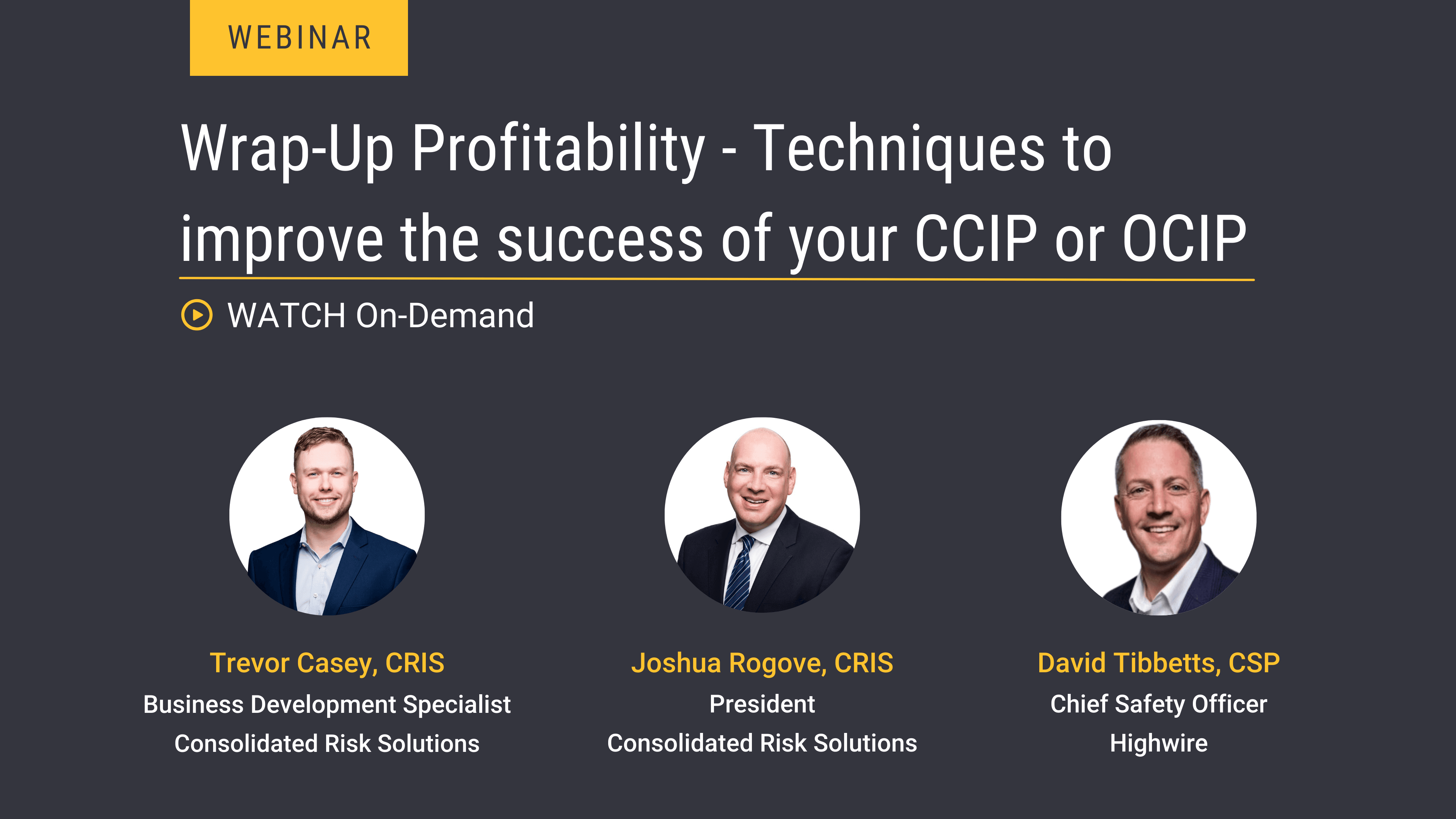
In this episode, Highwire's Chief Safety Officer, David Tibbetts, talks with Joshua Rogove, President, and Trevor Casey, New Business Development Leader at Consolidated Risk Solutions, about how to improve the effectiveness and profitability of wrap-up insurance programs (OCIPs and CCIPs).
They share lessons from years of experience, covering key risk factors during bidding, managing claims mid-project, and boosting safety performance. The conversation highlights the importance of early team buy-in, strong communication, and using technology to drive results.
Whether you're an owner, GC, or administrator, this episode offers practical tips to strengthen your wrap-up strategy.
Meet the Guests

Joshua Rogove, CRIS
Consolidated Risk Solutions, President
Joshua M. Rogove is the President of Consolidated Risk Solutions (CRS), an independent insurance wrap-up administrator. Rogove drives a client-first, agile culture at CRS, where he promotes innovative thinking through technical leadership and industry knowledge based on over two decades’ of experience in the sector.

Trevor Casey, CRIS
Consolidated Risk Solutions, Business Development Specialist
Trevor Casey is the Business Development Specialist at Consolidated Risk Solutions, an independent insurance wrap-up administrator. Casey’s background includes specializing in large scale construction and risk insurance. Casey works with an array of clients, including general contractors, owners, luxury home builders, and more.
Related Resources

Transcript
[00:01:00] Dave: Thank you for joining us for our webinar on wrap-up profitability techniques to improve the success of your CCIP or OCIP. My name is David Tibbetts, and I'm the Chief Safety Officer here at Highwire. And today we're delighted to be joined by Joshua Rogove and Trevor Casey of Consolidated Risk Solutions.
So, as a certified safety professional who works closely with Highwire's owners and GCs to help deliver safe project outcomes, I get to learn about the challenges and successes of our customers across the country that they experience as they manage the complexity of their insurance programs, and especially wrap-ups.
Prior to joining Highwire, I managed the construction safety program at Harvard University, where Highwire was created, and it was really created out of a need. A need to help, to be a part of turning around the performance of Harvard's wrap-up.
And we'll talk a little bit more about that today. But what Highwire really does today is help owners and GCs assess the risks of their contracting partners, engage with them to ensure that action plans are being developed when necessary, and monitoring performance during construction. Really collecting valuable data that drives continuous improvement.
All of this with the goal of elevating the performance of each trade partner. I'm glad to have Josh and Trevor here to share their expert opinions and experiences as wrap-up administrators. And so let me start by turning this over to Josh and Trevor to introduce themselves and CR solutions.
[00:02:28] Joshua: Thank you, everyone. My name is Josh Rogove, president of CR Solutions. I have been in the construction casualty insurance business or space for over 20 years. CR Solutions has been in business since 2002, so we just recently celebrated our 20th year. I'm based up in our New York office.
We have a centralized service center down in Alpharetta, Georgia, under the direction of my partner, Jennifer Philippi, where we have teams broken up down there that specialize on the different product offerings that CR solution supports. Byline wrap-ups, workers' comp, GL. Byline programs, GLLE, and insurance tracking services.
I'm excited to be here today with Dave and the Highwire team just to really talk about our experience with wrap-ups and really discussing how the evolution just using technology how we've seen, where, back when we started, we had people out in construction trailers and we were pushing paper and the insight into the data from the site wasn't what it is today.
And with the continued advancement of technology, we're looking forward to where things are going. I'll hand it over to you, Trevor.
[00:03:28] Trevor: As Josh said, and Dave said, I work with CR Solutions, Trevor Casey, down in the Atlanta office as a business development specialist. I've been working alongside Josh, helping owners and GCs really learn how they can save money and CCIPs and OCIPs, and implementing products to help do so.
Um, have worked with CR Solutions for a few years now. Started on the administration side, slowly moving into account management. So I really have the day-to-day understanding of how a wrap-up works. Really understood and have slid into helping Josh. So excited to be here.
[00:04:02] Dave: Josh and Trevor, thank you for that introduction, and really excited to share some of our experiences today. First question that I'll ask is among the wrap-up customers you all work with, how many are running successful or profitable wrap-ups?
Do you guys feel like that's getting easier or harder in the current market? And Josh, how does profitability vary amongst your wrap-up customers?
[00:04:24] Joshua: Yeah, Dave. It's a tough question because a lot of, a lot of the experience, unfortunately, is impacted by the environment the project is in.
Certain states have certain laws that increase claims, where, if the same issues happen in other states and New York being one example. While in different jurisdictions, there are different reasons for implementing these wrap-ups. So in some areas of the country, it's implemented more for risk management bebenefitsIt's the only way for a sponsor to ensure all contractors working on a particular site have proper coverage. And then, as far as the profitability in states where a well-run wrap-up is implemented and the culture is bought in on the site, and it's really pushed down from senior management.
You can drive out potential savings. But really it's, it depends on the market that you're in, and it really depends on how the wrap-up program is pushed out to the team members.
[00:05:13] Dave: All right, great. Thanks for that. Can you just expand upon what you mean by peace of mind, just for our audience?
[00:05:19] Joshua: Sure. So the benefit of the wrap-up is, we call it sleep insurance. So it's essentially the contractors, the general contractor, and the owner know that everyone coming on the site is covered by the actual policy that's put in place. These policies typically have coverage that's dedicated again to the project, hopefully limits reinstate annually, and then they have a completed operations tail. Under traditional insurance, you're dependent on subcontractors who have their own coverages that renew at multiple times throughout the year.
They're choosing the coverage. So, through the premises time without a wrap-up, you're relying on that transfer to subcontractors. Once we get to completed operations, now you have to hope those subcontractors remain in business, and if they do remain in business, that they do maintain the proper coverage.
So the wrap-up does provide that peace of mind throughout the course of construction. And for a period of 10 years beyond or the statute of repose, whichever is less.
[00:06:12] Dave: Okay, perfect, thanks. I think Josh said some interesting things there and certainly phrased it in an interesting way. One thing to really think about is that profit doesn't just appear because the project was a good fit for a wrap-up or insurance cost savings; they don't appear. The project or projects that are in a rolling wrap-up need to perform well from a safety perspective for the sponsor to realize the insurance cost savings an OCIP can provide. Or for a GC or CM to realize the potential profit a CCIP can offer.
The financial benefits wrap-ups can provide are significant, but the sponsor has to be ready to execute, and I think we'll talk a lot more about the importance of culture and engagement in wrap-up success as we continue our discussions today.
What are some of the typical traits among wrap-up customers that are seeing really good results? What challenges do you see among customers struggling to meet their program or performance objectives, at least initially?
[00:07:07] Trevor: Honestly, I would say the biggest thing here is consistent messaging is gonna be key, right?
So, where a CCIP or an OCIP is gonna be the most successful is where senior management is bought in and has a high rate of success for safety. So you have the project team that's gonna be on site, they're truly bought in. Senior management has bought in that C-suite all the way up. And so buy-in starts at the top and works its way down.
So one of the other things that we're really seeing is contractors embracing things like technology. Using things such as wearables, cameras, and sensors. Putting different kinds of technology in their builds that are helping improve safety. Connecting that technology to software so they're actually having a live view of what's going on.
So really, the biggest thing we see in claims is gonna be poor decision-making, right? So when I was talking about that top-down buy-in, so sometimes you have a high-level top in buy-in, but it doesn't trickle down, and you can't just throw any kind of project team at a CCIP.
Traditionally, you want a project team that's gonna be tuned in, bought into the people that are on site, bought into the project, and really have a keen eye to safety. So just making sure that having a safe project is not just saying, okay, we're gonna have a safe project. It takes a little bit more than that.
But back on that safety side is really the best run wrap-ups to have that safety really are, have communication at the forefront. So, especially important during the bidding process, making sure that they're smooth and effective communication between the contractors, the project team, and everyone, so that they know what to expect in the bidding process, what is expected of the program, so that there's no surprises at the end.
[00:08:52] Dave: What you just said is hugely powerful and important, Trevor, and I want to just emphasize that a little bit here. Setting expectations for the contractors as they are getting enrolled, as they're getting prepared to start on-site. And I really think emphasizing the importance of the teams that are supporting the wrap-up.
I don't think we can really overstate how important that is. And one thing that I heard both of you guys mention as we prepared for this webinar is that you can get a sense pretty early on in a project of a team's level of engagement or level of commitment, right?
[00:09:24] Joshua: Yeah. And it's definitely, it's a change of culture, right?
Under traditional insurance, the risk management approach is risk transfer. How do I ensure I can pass the insurance claims of that subcontractor? Under the wrap-up, everyone's covered. The downside is you're responsible for every deductible or from every occurrence that happens.
So it's the buy-in from the top that puts, that sets the stage, but it does really have to trickle down as well. Like you really, we've seen successful programs implemented with incentive programs. Making the workers feel like they're part of the process as well.
Because the better we treat them, the cleaner the project site is, and then usually that translates to better loss experience.
[00:10:04] Dave: You really have to keep everybody engaged throughout. As a safety professional, I've felt the same in my experience in terms of getting a sense for an organization's culture or their level of commitment.
As early as a project commit, uh, kickoff meeting, you can get a sense of the project team's level of engagement when it comes to safety. And it chimes through at various stages of pre-construction. Are key team members other than safety involved in pre-construction meetings? Is safety a focus of weekly project meetings? And is that data that's collected, like Trevor, you just talked about wearables and other technology, all of that's giving you great data.
Is that data reviewed on a weekly basis? Are we reviewing upcoming activities to take a look at? Hey, what's coming up that is high-risk work? That has the potential to result in serious injuries or fatalities if we don't plan that work and execute it.
[00:10:55] Joshua: And to circle back real quick, Dave, just on the profitability, sorry to interrupt you there.
The other beauty of the wrap-up is because it's a long-term project, it's not set it and forget it. You're getting the insight. You're seeing, okay, what types of trends are we seeing? Should we focus the next toolbox talks on these? We're just, we're learning from the data that we're using, and it's not like to the underwriter or to the sponsor, okay, I bought this policy, let's keep our fingers crossed and hope that in five, six years from now, I get money back.
No you, unfortunately, you may have a claim upfront, but that's not too late to still create a, have a successful project. So I think just the knowledge and insight of what's going on, and that's the use of technology, and that's the evolution of the product as well, is happening due to the speed of the technology advancements.
[00:11:43] Dave: Yeah, exactly right. Just because you've had a claim or a couple of claims early on doesn't mean the fate of your OCIP or CCIP is sealed. I'll share a little bit more about our experience at Harvard with our OCIP later on, that I think will shine some more light on that.
You really can't influence change even during the course of an individual project. And in a lot of ways, it's the data, how you share the data, how you communicate the data, and what you do about that data. And one last thing that I would add is a contact of mine that works for a very large tech organization.
They are running a very successful wrap-up program. They told me that on almost every occasion when they see a project that is performing poorly, they find that there's really a lack of engagement. Leadership engagement, field-level engagement. And when they really sharpen their focus on that engagement, they see almost an immediate turnaround in performance, and that resonated with me.
And it really emphasizes the impact that project team members can have when they are engaging the workforce and really building a strong safety culture on a project or on a wrap-up. Let's uh, shift our focus to the bidding process and how that can change on a wrap-up project.
What are some of the additional risks or concerns, or challenges that need to be considered in that bidding process when there is a wrap-up program?
[00:13:02] Joshua: We discussed from a risk management standpoint, the wrap-up is a superior product. There is potential for savings, if you run it well, but there's also the, there's gotta be the financial savings upfront, right?
Cash is important to everyone. There's gotta be that financial gain. So there's really different ways for sponsors to bid out these programs. They could either ask for all subcontractors to bid gross, inclusive of insurance, then have someone like CR Solutions come in, confirm what their insurance costs are, and then do an actual deductive change order to remove that contractor's cost of insurance.
The other method is to have subcontractors bid net of insurance and identify their insurance costs as a line item outside of their bid. It's identified as an add alternate, and it's only paid to them in the event that the wrap-up is not implemented. More owners go the deduct route, more GCs go the CCIP route.
At the end of the day, you should end up at the same dollar amount in theory. The sum of all the credits from the subcontractors will ideally cover the wrap-up cost. So to a sponsor, it can almost be cost-neutral. But then that's where, really, the culture and working with Highwire that's where you're really gonna drive out the savings.
Because if the carriers put out a program where you had instant savings day one, it creates a moral hazard because then why are you gonna spend more money on safety? 'Cause you've already made that margin. So typically the sum of the credits that come out, either through deducts or add alternates, will help fund the program.
Now, where we see a flaw in this method is it almost creates adverse selection because if two contractors that, let's say, have the exact same labor material costs, and let's just assume bids are just labor, materials, insurance, and overhead and profit markup. If we have two subcontractors bidding the same job, let's call it a deduct job. Both bid, they both have the same identical labor and material costs, and one subcontractor pays $300,000 more than the other subcontractor.
Under the deduct approach, if we're going in low to the same, like low bid. The subcontractor that's paying more in insurancetheir bid's gonna come down. So they're gonna look like the better contractor to award the job to, whereas that subcontractor is more likely paying more in insurance because they have worse loss experience.
What we're trying to figure out and help the industry with is really, yes, like the deduct or the credit that the subcontractor is important to help, help level them. But there's really more you need to know because I might wanna enroll this contractor. They're low bid, but if they're gonna be the culprit of three or four more claims, and in certain states you have deductibles as much as a million dollars, now we’ve kind of reshuffled the deck.
[00:15:44] Dave: Yeah, I think that's really helpful. In a sense, you're almost penalizing a contractor who has had better past performance, who has a lower EMR, who is paying less for insurance, because you're leveling the playing field for that contractor who hasn't performed as well.
And I think that it's great that wrap-ups can level that playing field for contractors that may have not been able to bid with traditional insurance. Maybe you're able to include some smaller contractors. Maybe you're able to include some disadvantaged businesses that you know, help you meet your goals.
A lot of sponsors have goals around including disadvantaged businesses in the bidding process and ultimately awarded, and it helps to include some of those, but you've got to be careful when you're considering who is going to work on your project. You've got, you have to understand the risks that they present, and it was really one of the things that we realized at Harvard when our OCIP was not performing. Is that we really didn't know enough about the contractors bidding on our work.
We didn't really understand the risks that they were presenting, so that we could engage them more effectively. And we knew that we needed to do prequalification, but it needed to be more than just a check box exercise. We needed to look beyond the EMR. This was really an important shift that helped us build culture and awareness.
With insights into each contractor's risks, we could ask critical questions before contractors began work on site. We could require development of data-driven action plans when they were necessary, and it really helped Harvard and the wrap-up team focus their efforts in the field.
We knew what we needed to focus on, and it was extremely impactful.
And so if we shift a little bit again here, we know that part of your service involves meeting with program sponsors frequently to report on performance. What are some examples of key data points or insights you present during these meetings? And what do you feel is the most valuable metric to track performance?
[00:17:35] Trevor: Yeah, absolutely, Dave. So first for the day-to-day experience, right? So the kickoff meeting is essential to set expectations and really get the project team bought in on the project. We'll discuss claims reporting procedures, key contacts, and really discuss like day-to-day operations of the project. Attendees can include the project owner, broker, project team, obviously, CR solutions, any attorneys that may be involved in the project. Anyone that really has a buy-in factor of part of the project is gonna have a reason to be there.
So once a month, after we've completed that, we're gonna really have a participation meeting. It's really gonna be only a 10-15-minute meeting once a month. Just going over who's on site, who can be on site, who's not allowed on site for insurance reasons or payroll issues that we may be having. Have a quick overview of upcoming work, the scopes of those work that may have enrollment exclusion. When we expect them to be on-site and when they should be off-site. We also will discuss the compliance, as I said, who can be on-site, who can be off-site. So when I say who can not be on site, there may be a reason in their insurance that's excluding them from having the ability to be on a wrap-up.
That might need to be amended. Making sure that the GC and the owner actually is covered for the work that's being done by somebody else. And then another item that we'll discuss is the closeout. Who's actually finishing up work, who's starting to get offsite, what's their final exposure information, ensure they have any paperwork that may be needed to button things up for final payroll, final compliance. And identify any work that may need to be completed beyond the CCIP for some TNM-type work.
And making sure that their insurance is compliant to continue that work on the site. So that's really gonna be the overall day-to-day. And as I said, the most important piece of that is that kickoff meeting.
[00:19:31] Dave: I think it's really interesting how you frame it as a participation meeting. One of the things that helps you get a sense of commitment and engagement is, are people really participating in these meetings in a meaningful way, right?
[00:19:43] Trevor: Just showing up and listening is not always going to be the best. You wanna have engagement. That's where that communication piece comes in play.
[00:19:51] Dave: I wanna highlight something we've talked about a little bit here. We've talked about claims and claims reporting. The name of the game when it comes to wrap-up success is running a safe project. Running a safe project should result in fewer injuries and less severe injuries.
But when injuries do occur and claims are filed, the middle name of the game should be incident management. And you might think there are two parts of this. First, when an incident occurs, it's investigated thoroughly so that lessons can be learned and shared.
And second, an extremely important aspect to wrap up success is that the claim is managed and monitored closely. So it does not get lost and costs don't balloon, right? Have we established a relationship with an occupational health provider? How and where are injured workers being treated? What follow-up is required?
How quickly can we get those workers back to work? Do our trade contractors have well-defined return-to-work programs? All of these things should be included and communicated clearly in the wrap-up manual and then executed upon, right? Josh, can you talk about what's involved in a claims review meeting and how it helps inform project teams?
[00:21:00] Joshua: Sure. So we don't actually, from a CR solution standpoint, we don't get involved with the claims more from a reserve adequacy type approach or how the claim is, the claims adjuster's handling. We take the information and data that's provided from these loss runs, and really, we don't look at a granular level, like we're not looking at the individual employee name 'cause that's really not relevant.
We're looking more towards which subcontractors are the culprits on these programs or where we're seeing more loss activity. What types of injuries we're seeing? And then really again, using that data and information to try to perfect what's going on the project site. But typically at these claim reviews, it's, they usually happen quarterly throughout the project. It's good for all parties to be involved. It's very informative for a project executive to see an injury or hear about an incident and think it's no big deal.
And then to be sitting in a claim review six to eight months later and see this is now reserved for seven figures. Then it becomes real, and the lights go on that this is something, so at the claim reviews again, it gets into reserve adequacies, are we doing investigations?
Is there potential for fraud? Our involvement is more claim happened, okay, let's now learn from the data that we're seeing as to what types of injuries are happening. So we avoid them from happening more in the future where they, that we don't spiral outta control on the project.
[00:22:22] Dave: Yeah. Perfect. I think staying on top of that project sponsor has to be aware of what's happening from a claims perspective. Where does each claim stand? Are we actively managing it? What types of accidents are happening on our project?
What contractors are involved in accidents? What body parts are being affected most frequently? That is all real data points that can be actionable. And again, just because you're, your wrap-up is off to a bad start doesn't mean that you cannot influence that change.
It's a really important point. And if I think about what was happening at Harvard in the first year, 18 months, two years, of that rolling OCIP, our claims costs were really high, over $7.50 per a hundred dollars of payroll. Much higher than anticipated when the OCIP was bought out, right?
Where we thought, hey, we need to hit around $3 or $3.30 per hundred dollars of payroll. Somewhere around there. We knew that if the OCIP was to continue down that path, it was at risk of costing the university more than traditional insurance. Not to mention that the fact that we were having a lot of incidents, which we did not want. We did not want people getting hurt. We did not want the public being exposed to any issues. We needed to turn performance around. And we did that, right? And we did it through being able to evaluate workers and contractors consistently before they were brought on site.
We did it by implementing a more robust OCIP manual and EHS standards. We really were trying to foster. More engagement of the project teams. We were increasing on-site presence of all of our wrap-up partners so that we could monitor performance and aggregate data, and take action better.
Closely monitoring the claims, investigating every incident, conducting post-incident review meetings, and really collaborating with the whole wrap-up team, including our GC and CM partners. Our brokers, our carrier, our administrator, so that we could all address trends and share that information as those things were emerging.
All of it helped us build a really strong safety culture, and I think that was felt across all of our projects. And just to wrap it up, in the end, with that shift in mindset, dedicating some new resources, a heavy emphasis on engagement, we dropped the final claim cost to below $2 per hundred dollars of payroll.
That allowed the university to realize the insurance cost savings the OCIP had promised, and then some, because of really good performance in the end. That is just a good example of a story of, hey, just because you've started off in the wrong direction doesn't mean you can't turn it around.
A closing question here is, you know, what capabilities should an owner or builder look for in a wrap-up administrator?
[00:25:04] Trevor: Experience in administration and understanding the products are huge pieces of this, but truly, the name of the game is having the right people who know how to communicate to all different levels of the project is really the specialty of a strong administrator. And secondly, administrators should not be an impediment on the project. They're really just a resource to ensure that all of the parties have everything that they need to achieve the product success and the goals, and making sure that they're on time and on budget.
[00:25:33] Joshua: Yeah, and I would just add there, Dave.
I think just understanding today's environment, fast pace. Insurance is not everyone's priority, but fitting ourselves into the process so that we're ensuring that. Where everything's buttoned up on that side. No one is accessing the site without some kind of administrator clearing them to ensure that either they're properly enrolled or can come on site, and their own insurance will respond properly.
And just I think technology, today, CR solutions, we're part technology company, and then also we support it with the service. So I think again, with the speed of technology, I think continuing to have and with Web 3.0 and Internet of things, like. Having the ability to be collecting this data, but also sharing it with people, because the data in our silo is only useful to us.
If we can share that data with firms like Highwire and then it could be brought into project management systems even now, we can help you make, try to make more informed decisions on a particular project. But if you could now take your experience and work on your overall portfolio, I think the data from a good administrator is key. We're out there, communicating on behalf of a lot of times the GC to a lot of subcontractors. So, really explaining to them, this wrap-up thing's not scary.
This is how the process is gonna work. This is why you're not double-paying for yourself. When you do enroll, we're gonna give you a certificate of insurance that you're gonna give to your own carrier. You're not gonna be double-charged for this. This might actually be good because you only carry $10 million in limits, and if you wanted to bid this job, you needed 25.
So now this is giving the availability to join this project. So it's really just being part of the process, not an impediment, as Trevor said.
[00:27:09] Dave: Exactly right.
In an OCIP or CCIP environment on a wrap-up, I think one of the things, there are a couple things that are shining through in our discussion today. One is the importance of data, right? And I think the industry is really recognizing that, hey, we are collecting a lot of great data. We have to figure out how to put it to use in the best way.
'cause it's hugely impactful and actionable. And I think that the other thing that's shining through is partnership. You guys are a partner; everybody in the wrap-up world should be thought of as a partner. It's a strategic partnership. Everybody's trying to achieve success that a CCIP or OCIP can promise. Engaging the right wrap-up administrator can make a huge impact. It did for us at Harvard. The services that you guys provide are critical. And I really encourage everyone listening to take full advantage of the services that your carrier has to offer you, that your broker has to offer you, that the wrap-up administrator has to offer you. And if we come back to one last thing that shined through today is the team.
When you are a sponsor, you have to really consider very carefully the team that you have built. You have to consider the culture of your organization. Are you ready to execute on a wrap-up program? The stakes are higher. You have to be ready to execute. The best project team on a single wrap-up project.
But if you've got a rolling wrap-up program with multiple projects, you need that culture embedded so that every team is prepared to perform.
And yeah, I think that those are some really important points that could be some good takeaways for everyone here.
I want to thank Josh and Trevor for providing their insight today.
I think we really covered some really important, uh, topics. You wanna learn more about Highwire, you wanna learn more about CR solutions, or just ask questions, we'd be happy to handle those and uh, share some more experiences.
We appreciate you taking the time to join us today.