AI and the Future of Safety Inspections
What separates inspection programs that truly prevent serious injuries from those that simply generate paperwork?
In this episode of Beyond Prequalification, Highwire’s Chief Safety Officer, David Tibbetts, is joined by Caitlin Bergin of BSI and Corey Silverman of Highwire to explore how organizations can turn their safety inspection programs into one of the most powerful leading indicators in their safety management system.
They discuss why inspection volume doesn’t equal inspection quality, how misaligned goals and low-risk “easy” findings dilute impact, and why leadership engagement is essential to driving meaningful improvement. The conversation also highlights practical applications of AI in the field and how these tools can reduce friction, improve data quality, and help teams focus on high-risk activities.
Whether you’re an asset owner, general contractor, or trade partner, this episode offers practical guidance on using inspection data to strengthen partnerships, surface emerging risk, and drive continuous safety improvement.
Meet the Guests

Caitlin Bergin, CHST
BSI Consulting, Senior EHSS Consultant, Manager
Caitlin Bergin is a Construction Health and Safety Technician (CHST) and Senior EHSS Consultant and Manager at BSI Consulting. She partners with sophisticated organizations to strengthen safety culture, improve operational performance, and reduce risk through practical, results-driven EHS strategies. Caitlin brings over a decade of experience across construction and corporate environments, with a focus on sustainable, long-term solutions.

Corey Silverman
Highwire, Safety Specialist
Corey Silverman serves as a Safety Specialist at Highwire, bringing a hands-on, solutions-driven approach to risk identification and safety management. He collaborates directly with clients to strengthen their safety programs, enhance job site safety performance, and promote a proactive approach to managing risk throughout the project lifecycle.
Related Resources
Transcript
[00:00:00] David Tibbetts: Welcome to Beyond Prequalification, a podcast where we explore the tools, strategies, and stories that shape the future of contractor management and deliver contractor success. In this episode, I'm joined by Caitlin Bergin of BSI and Corey Silverman of Highwire for a conversation about the importance of an effective inspection program, a core component of any safety management system that warrants attention and certainly warrants investment.
We reflect on fatality rates and construction, and how they have remained flat over the last 15-plus years. Why inspection volume doesn't translate to inspection quality, and how leadership engagement and better data can shift inspections from something we do just because we're supposed to, into a true leading indicator.
We also cover how AI can deliver meaningful improvements to your process, making it easier to capture findings in real time, surface trends, and hopefully generate higher-quality data. I'd love to hear your thoughts about this episode, so please feel free to reach out to me at Dave@Highwire.com.
Good afternoon, good morning, good evening, depending on where you are in the world. Thank you all so much for joining us. I'm assuming everybody's joining us today because you are interested in understanding how to improve your inspection program. Some of the applications of AI that are either real today or coming in the not-too-distant future. You really understand how important an inspection program is to your overall safety management system.
[00:01:43] David Tibbetts: I would ask you to think about this as well. Is your company's inspection program as effective as it could be or as you would like it to be? And if the answer is no, why not? What are some of the challenges that you're facing with your inspection program?
So, just a little bit to frame the discussion here. I'm joined by Caitlin Bergen and Corey Silverman. I'll have them introduce themselves. Caitlin, if you could introduce yourself, your role, the work you do, and how and why you conduct inspections today.
[00:02:11] Caitlin Bergin: Yeah. Hey everyone. Uh, thanks, Corey and Dave, for having me on today.
I'm really excited to be here. My name is Caitlin Bergin. I work for a company called BSI. We've had the pleasure of working with many companies across the world to build and expand their safety programs. And, you know, I've also had the opportunity to build a world-class safety program for a client that I've been supporting for around six years.
And, uh, Highwire has been a really big part of our story and continued success. So happy to be here.
[00:02:40] David Tibbetts: Awesome, thanks. And before I turn it over to, uh, Corey, Caitlin, what are some of the ways, inspection-centric or not, that you've been using AI to support your work at BSI and support the work that you do for your clients?
[00:02:53] Caitlin Bergin: Yeah, good question. It's out there. It'sa real tangibleuse case now. So we're still in our early stages of AI adoption, but we're already using it forwriting efficiency, helping to improve the speed and quality of our writing, being more efficient with tasks, kind of using it as a force multiplier, so it can give us back a little bit of time for the work.
Uh, where can we actually utilize our own expertise and judgment, as well as task analysis? What I really love about using AI is that I don't necessarily have to start from scratch. I can use AI to build a skeleton, and then from there I can populate like my full solution and put that lovely bow on it to show to our clients and other colleagues.
[00:03:35] David Tibbetts: Certainly a, a huge help in sort of program development, program improvement. the, the, uh, you know, the level of detail and sophisticated programs that can be developed through the use of AI. Of course, all of those need to be reviewed and tweaked, right? They need to be specific for your company, but there is no need to start from scratch anymore.
Here at Highwire, we've incorporated the use of AI for analysis of safety programs and management systems. Certainly a very tangible use case, something that we spent, really, over a year developing, but has proven to be very, very effective for us. Corey, if you could introduce yourself. Uh. Your role here at Highwire, why you're excited about the topic?
[00:04:16] Corey Silverman: Yep. My name is Corey Silverman, I've been with Highwire for about two years.
I've been in the safety world in a variety of roles for about seven years. been a part of a lot of different inspection programs for a lot of different organizations, so I'm really excited for this conversation. I think inspections are one of the strongest ways to evaluate modern state performance, especially when we think about the shift in recent years from focusing heavily on lagging metrics, TRIR, EMR, DART, to kind of try and incorporate leading indicators and those insights to evaluating safety.
So I'm really excited for this discussion.
[00:04:49] David Tibbetts: Great. Thank you, guys both for joining today. I'm gonna start with a refresher of sort of where we're at, right?
And this is all meant to frame the discussion around inspection and the importance of an effective inspection program. Uh, we know that at least here in the United States, fatality rates in construction have been essentially flat for the last 15 years. We really haven't been able to impact those rates in any kind of tangible way.
So this is the trend over the course of the last five years. But fatality rates have tended to hover around 9.5, 9.6 for the last 15 years or so.
Uh, the reason why I mentioned that is 15 years, right? For 15 years, fatality rates have essentially been flat, all the while recordable rates are decreasing significantly, by upwards of 50% over the last 15 years. Fatality rate in 2011 was 9.1, 9.1 fatalities per a hundred thousand workers each year in the construction industry.
That was the lowest point that it ever got to. You can see that it's actually higher than that today, but again, generally hovering around that. So, um. You know, we need to do things a little bit differently if we're gonna impact fatality rates in construction. The other thing that I thought was interesting, everybody recognizes that fatal falls are the number one cause of fatalities in construction.
It's been that way for as long as anyone can remember, right? We know that falls are the leading cause of fatalities in construction every year. We know it's the number one most cited observation. It's probably the number one, most common unsafe behavior that you note on your construction site?
Certainly, the most severe unsafe behavior that you commonly note on your construction projects is that I knew the numbers, but I haven't really looked at them for a while. It's jarring to see that over the course of the last four years that we have data for, it's increasing year over year.
And of course, I recognize that there are varying numbers of work hours over the years. But still, I would really expect to see us be able to start impacting this, hopefully sometime soon. It's jarring to see that these numbers have increased year over year. The other thing that I want to note is that we're in this really challenging time in the world of construction, where certainly a lot of firms are worried about their ability to find an adequate supply of workers, the quality of those workers. Whether you've been impacted by a labor shortage today, or maybe you will be in the future, when we combine the fact that we might be struggling to find qualified workers, or we might be introducing newer, less experienced workers into this industry, which is a very dangerous industry.
When we combine that with the incredibly aggressive schedules that we're trying to meet today, it's really a recipe for a major challenge, right? And when we think about fatality rates and our inability to impact that, if we're not able to tackle this potential labor shortage, handle these newer, less experienced workers in the face of these incredibly aggressive schedules, we are gonna continue to have some significant challenges.
So this is all relevant to the topic of inspections today, and we'll kind of make those connections as we go. hopefully many of you are familiar with the Construction Safety Research Alliance. They're doing some incredible research, and they are providing some amazing resources around prevention, right?
Preventing serious injuries and fatalities. And one of the studies that they did recently was around Decluttering safety, right? removing safety clutter, focusing on high-value exercises, the things that are most likely to make impacts, right? As part of this study that they did, they also referenced this definition of what safety clutter is.
It is the accumulation of safety procedures, documents, roles, and activities that are performed in the name of safety, but do not contribute to the safety of operational work. The reason that I bring this up, number one, is to introduce this resource because I think it's very valuable. It's a great read. I would encourage folks to go to the Construction Safety Research Alliance website to find this, along with all of the other resources that they've developed.
But the point that I want to make here is that inspections and an inspection program never is and never will be safety clutter. It is not pure clutter. It is not incorrect. It is not obsolete. An effective inspection program delivers value. It identifies insights that are actionable, that influence change and improve performance.
It should be a core element of what you're doing in your safety management system. Caitlin, in your opinion, and based on your experience, I do want to ask you, why do you think that it's so important to have an effective inspection program?
[00:09:21] Caitlin Bergin: Yeah, good question. In my experience, I've seen how inspections can actually save lives.
We're conducting inspections to see how work is being performed and not just how it should be on paper. It can show us what's working, where we may be slipping, and steps that we can take to improve our safety program and our management system. Inspections are sort of a, a, a leading indicator for me of, of potential incidents later down the road, right?
We're catching something that's high risk, or we're noticing a dangerous location where a bunch of people are working. That's all incredible data that I can use to then, you know, inform the, the field on, uh, the field team on the ground as well as my leadership around. Hey, we need to make some changes for future schedule.
Here's how we can use our inspection data to drive change before we're forced to do it because somebody gets injured.
[00:10:15] David Tibbetts: Yeah, great point. It it is one of the best leading indicators. Right? And one thing you said there that is you hear in a lot of discussion, is it gives you insight into work as done versus work being planned.
Right. We know that work is not always executed according to plan, and when it's not, we need to identify any issues that are present in the field and take action to address it at that moment. Right? Based on that individual observation, we can take action to influence improvements on a project based on some aggregated data.
And then we can take a look at our organization and our safety management system at a as a whole. But that really requires our inspection program to be effective, right? Not just be something that we do because we know we're supposed to do it, but it requires us to make sure that the inspection program is effective.
I'm just gonna bring up identifying some of the common challenges that we see with inspection programs. Some of the things that I think of that are most important is that we're getting poor quality inspection data, which is that we've got people out in the field and they're doing inspections. But it's, to some degree, it's a check-the-box exercise.
We're not getting good quality data. Maybe we're not getting quality inspection data because the process of conducting inspections and making those observations is time-consuming, and it's difficult for people to do amongst all of the other things they have to do.
Or maybe we're establishing inspection goals that are driving some of the wrong behaviors. Some of the other challenges are that, based on the way that your inspection program is run today, maybe it's difficult to get insights because the data can't be aggregated, and so the data can't be used to influence change. And when the data isn't used to influence change, we might experience a, uh, some fatigue around our inspection program or a lack of commitment to our inspection program.
One thing that I want to point out on this list that I think is incredibly important, and this ties back to poor quality inspection data as well, is that we tend to have a lack of focus on the highest risk activities. When we tie that back to the fatality rates that we saw, the trend with fatal falls in construction.
If we don't have focus on the highest risk activities, I'll just say it bluntly: What are we doing right? If we're out there and we're looking at the things that are easiest to look at, because we need to hit our inspection goal, we are not getting value from our inspection program.
So we'll talk about how AI might be able to help us focus on the highest risk activities as we go forward as well. Corey and Caitlin, Corey, I'll turn it over to you first. What resonates most with you on this list? What have you seen as the challenge? What, you know, in talking to, to our clients or in your experience?
[00:12:53] Corey Silverman: I think that a lot of these are interconnected, but to me, the one that embeds with all of these most is leadership engagement. Leadership not being engaged and involved in inspection program is just gonna piggyback on all of these and drive 'em even further.
We talked about the poor quality data. To me, the biggest driver of poor quality data is that poor quality data is easy to make. When you're an inspector, it's easy to observe someone wearing their PPE. Um, housekeeping, you know, those low-hanging fruit categories that are easy to make observations in, but don't really drive the insights. You need to have a robust inspection program. When leadership's not engaged, and you know that no one's gonna be looking at these reports, and you have a findings quota you need to meet, you're just gonna make the easiest observations possible and observe PPE, observe housekeeping.
When leadership is engaged, and you know that leadership's gonna be reviewing the inspection reports and the data, you're gonna be a lot more motivated to make higher quality findings and the high-risk categories insights that can actually lead to change.
And there's a few reasons there. One of them is that if you know that leadership's gonna be reviewing the data and making changes off of it, you're gonna be more motivated to give you that them proper findings and have your findings lead to change. The other thing is that when leadership is reviewing the data, you don't wanna get called out for making 50 findings in PPE and nothing in the high-risk activities.
So when leadership is involved in these inspection programs, it compounds and leads to much better data that can then piggyback and improve a lot of these challenges that we're seeing here.
[00:14:19] David Tibbetts: I appreciate all of that context. And one thing is that one of our jobs is to make our leadership understand why this inspection program is so important. Why does it matter? What is the value added? One of the ways that we can make that case is being by being able to deliver aggregated data at a high level to leadership, to let them know where our gaps are, where our risks emerging, whether that's from a contractor perspective, a category perspective, a project perspective across regions, whatever it is.
If we can't pull the data out to be able to share that data with leadership and say, here's why I think we need to focus on X, Y, and Z, then our inspection program is not effective. And when leadership is not engaged because they don't have visibility into the data or they don't understand why the data is important, that can be a threat to the inspection program as well.
When we talk about some of the ways that AI can help to address some of these challenges, sometimes it can be challenging from a software perspective or from a system perspective to get data in.
And if it's difficult, that could lead to a lack of participation, or it could lead to poor quality findings. So I'm gonna tee Corey up here. Corey's gonna share one of the ways that we are introducing AI into our system to kind of help make it easier for the inspectors out in the field to document their observations, the observations of what they're seeing, whether those are unsafe conditions, unsafe behaviors, or positive findings. Right?
[00:15:45] Corey Silverman: Yeah, something we hear all the time from our clients, that they want to make it as easy as possible to get the inspection data into the platform.
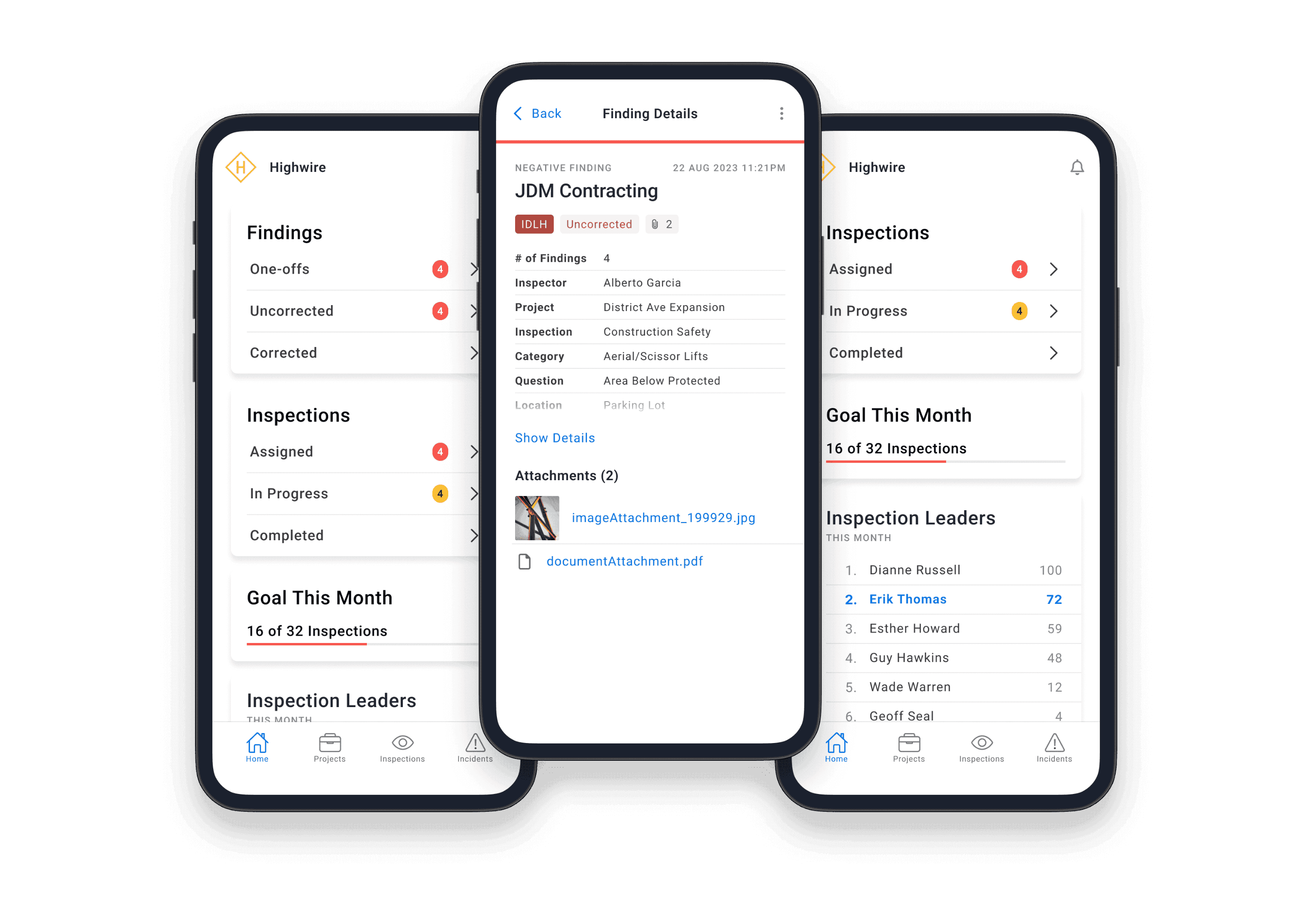
Fewest clicks possible, fewest fields to fill out. Just the easiest path of making the observation to getting it in the platform. And so that's what we went ahead and built with our new AI inspection tool. The way this works is that you're able to just press record, describe what you observe for 10 to 15 seconds, and then AI does all the heavy lifting of selecting the category, running out the description, filling out all the fields.
So again, what we're doing here is having AI take the manual work out of having to go through and select your project, select your category, select the contractor, write out a description, write out a location, write out the next steps.
And the idea here is that this is gonna help get users much more involved in doing these inspections. Hopefully, they'll be able to describe what they observe better than writing out, that's gonna lead to better quality. And just the fact that it's gonna be less clicks, less scrolling, less selecting is hopefully gonna drive more participation.
[00:16:44] David Tibbetts: Yeah. Great. I mean, Caitlin, I'm gonna ask you for your opinion about this and how you think this might improve some of the data that gets in. But I just wanna note, right, when you're out on a construction site and activities are kind of swirling around you, we know that it's difficult to pause, to bring out your tablet, to bring out your phone, and to start clicking around, right, to choose the project, to choose the category, to find the right question, to type things in. It's really difficult. That might contribute to either a lack of participation or folks finding the easy way out. You know, inspectors that are out in the field may not have the highest level of familiarity with the inspection checklist itself, what the categories are, what the questions are.
So when you narrate, and when AI is able to take that transcription of that narration and turn that into a structured finding that identifies the category, the question, the contractor, the corrective action, the due date, things like that. What we hope that will lead to is some better quality findings. Caitlin, but I'm curious, as you think about this application of AI, how do you see that this could help either help yourself when you're out in the field, or lead to better quality data?
[00:17:53] Caitlin Bergin: Yeah, I think I'm, I'm not alone in wishing that we had this years ago when we first got our start in construction safety.
I know for me, 13 years ago, when I entered into this, into this industry, it used to take a lot of time to create inspections. And even so, when, like to your point, when I'm in the field, and I have a lot of activities swirling around me, it really took a lot of focus to either pull out my phone, notebook, or a tablet to be able to stop, write a concise statement or observation with a picture, and then move on.
There can be challenges around software and being able to successfully get through, to enter the finding that you need to, and then move on. So I really love this feature. I think it can really improve the way that we capture our inspection findings.
And we're sometimes performing 20 inspections in a week just for one client, just in one region. So, you know, the fatigue is real as well as the kind of routine aspect can, can feel, you know, overwhelming and can contribute to low-quality data. So being able to, uh, support our inspectors who may be unfamiliar with the system or who may be just fatigued because they're, they're out in the field, they're performing inspections.
You know, sometimes for five projects a day, being able to simply dictate and then generate a high-quality finding seems like a total win. So I'm really excited for this feature.
[00:19:17] David Tibbetts: Yeah, I am too. And we essentially identified this as a potential application of AI a few months ago, and we were able to pretty rapidly do this development work.
Some applications of AI are more challenging than others; some might take months, and some might take a little bit less than that. But we're really excited about this, and I think from a team member out in the field, whether you're a safety professional or not, right?
Superintendent, field engineer, project manager, frontline supervisor, this ability to just narrate what you're observing is a great improvement. There are some other things that we are, you know, we see as practical applications, right? And these are again, really focused on trying to get better quality data and focus inspectors out in the field.
If any of you have experimented with analysis of photos or seeing the, the way that AI is analyzing photos in other applications. There's a great application here, especially for newer inspectors or maybe folks who are a little bit less experienced, to upload a photo of a work site or a work activity and basically prompt AI with, there's a couple of different approaches. One is to say, Hey, based on this photo, what should I focus my efforts on today? What categories should I focus on? Are there any obvious unsafe conditions or behaviors that could result in a serious injury or fatality, for example? AI is very good and continues to get better at analyzing those photos and pointing a, an inspector in the right direction.
Hey, there are some potential fall exposures here. I can see in this photo there's trenching and excavation work. You should make some observations in the trenching safety category, right? It's really effective at that. And that is a practical application that might exist out there already, but is certainly something that could be coming soon. The other thing to do is to say, Hey, we've collected all of this data, right? We're collecting all of this inspection data, and this comes back to surfacing insights. A simple prompt: I am going out to do an inspection of this project today. Where should I focus my efforts based on recent data? Right?
That's a, a really great application of AI. And another one is when you think about the volume of projects that you have responsibility for or that are underway in your organization, and you're getting data from every one of those projects every day, that can be difficult. To analyze and understand where you should focus your efforts, right?
Inspection data can really tell us what do we need to focus on today? So, looking across all of those projects and looking across the data and saying, where should I focus my efforts today based on all of my data? Where is my risk today? Can really help you sharpen your message to your teams, distribute your resources, and focus your efforts.
So, if anyone else has thoughts, how have you seen AI be used today? What are you seeing, what have you used, what has been effective? And then Caitlin, of those potential use cases around analysis of photos, prompting AI to say, Hey, where should I focus my efforts? How do you think that could help deliver better quality data?
[00:22:23] Caitlin Bergin: As I mentioned earlier, sometimes we are, are auditing multiple projects and have to change attitude shift for every single project that we go to, sometimes in, in one day. Once we're done inspecting certain sites or different projects, then we're left with a lot of photos, a lot of scattered words, and I, I really do think that, you know, AI in this application is great at consolidating thoughts, being able to consolidate data and make it accessible and palatable so that I can, you know, send out my daily reports.
Obviously, after verifying them, you should always trust but verify with any of these programs. Right? But then from there, I think being able to just have more free time to then analyze the data and have really meaningful conversations with your leadership and or clients. Like that's what they love, right?
They see the incoming data. They know there's a lot behind it, but they, they want sort of a simple, easy to access, easy to track solutions, type of report from you. So it actually just really frees me up to be able to get creative, to do trend tracking, to check against other job locations and trends, so I can either zone in on a company or zone in on a specific task. I think it really helps to keep you organized. That's a huge opportunity within the EHS industry, just staying organized with how much we're being asked to do and with the changing landscape and with the changing workforce.
[00:23:51] David Tibbetts: Yeah, absolutely. In addition to being able to surface some of these insights directly within the inspection application, if your process supports exporting all of your data to Google Sheets. Uploading it into a chat GPT or something like that, that's another great way to do it, with some simple prompts.
Where is my risk emerging? Which contractors are presenting the most risk across my projects? Which activities seem to be resulting in the highest percentage of negative findings or especially high-risk negative findings, or those findings that are immediately dangerous to life or health? When you combine it with things like work hours.
You can look at trends, right? If work hours are increasing, is my inspection activity increasing in parallel, right? If we have more and more work hours, but our inspection activity is remaining the same at the same level, then we're missing an opportunity there, and we need to address that. All of this data is meant to facilitate conversations at the project level with an individual contractor and at the leadership level.
Even as we wait for some of these AI-driven insights, it's important that your inspection program today can deliver insights to you, right? You can pull some insights out of your inspection solution regardless of the solution you're using, because if you're not using the data, to take action and facilitate conversations. You're gonna threaten the sort of overall perception or effectiveness of your inspection program. So I'm gonna transition over to Corey to talk about some of the conversations that should be facilitated that are really, really important.
[00:25:19] Corey Silverman: Yep. So we spent a lot of time talking about the importance of having good quality data, and so I'm gonna walk through examples of how you might use that good quality data to drive better performance on safety sites, related to your inspection data. Let's start with a very simple example. Let's say that you're a safety manager, you're working with a roofing contractor on a number of projects, and they're having a lot of issues related to fall protection, and you wanna see if your inspection data backs up what you're seeing in the field related to that, and use it to help drive performance improvements.
So what I'm gonna do is filter down to negative findings associated with that specific contractor in the category of fall protection.
And I'm gonna filter down to just the high-risk and immediately dangerous life and health findings. And so I've got them all right here now. I can use this to understand the trends, understand where these exposures are occurring, and help make performance improvement plans with this contractor.
You know, that might involve sitting down with leadership from this contractor and making a plan for how we're gonna prevent these future exposures from occurring on future projects. I'm not focusing too much right now on actually what those conversations would be.
I'm just trying to make the point that you need some sort of mechanism for being able to filter your inspection data down to insights like this. This is a really simple example, that's why I chose it. All I did was apply a few filters to a large data set, but I think it really highlights how powerful that can be.
Just applying a few filters and then using it to have targeted conversations to target the contractors who are struggling. So I think just a very powerful example of what you can do with inspection data. And I think whether it's highwire or whether it's something else, you need some sort of mechanism to be able to filter down your inspection data insights like this.
[00:26:54] David Tibbetts: One of the things that we talk about a lot here is, you know, we are in the business of contractor management, but maybe even more so contractor engagement. These types of insights drive engagement. This might be a really valuable partner who does great work in terms of the quality of work they deliver and their capabilities.
But when we have some risks that are emerging, we can't just use our intuition. We need to be able to back it up with data and when we, when we go to sit down and have a conversation, we can pull up insights like this and walk through them; it's really hard to argue with. Right. And at that point, it becomes all about how do we do better going forward?
So, Caitlin, I'm curious insights like these, whether they are contractor-centric, category-centric, or project-centric. How have insights like these helped you have meaningful conversations with your teams, whether that's your own internal teams, a project team, an individual contractor, whatever it might be?
[00:27:47] Caitlin Bergin: Yeah, I think we've used these insights to really drive home how important our inspections are and how valuable our inspections are. So much of the time, you see safety professionals on a walk, and they're performing an inspection, and the people that are performing the work are not always engaged with the findings or actually able to see the end product from your reports. And so on, you know, on the basis of tracking findings, it's a really great opportunity for us to, engage with contractors on specific high risk projects or if we're entering into a stage on our, on our job where we're gonna be seeing a lot of work at Heights, or we're going to be seeing issues with abatement and, potential PPE or exposure potential. Being able to actually engage with the contractor personally, show them leading indicator findings, actually, you know, it does, it does kind of encourage some accountability from the contractor, but I think it actually shows our partners in the field that we're watching them, that we're looking out for them, that we're here to partner with them.
I think that anybody who's performing unsafe work, or you know, work within a risk tolerance, doesn't want to see anybody get injured. They wanna keep doing their job and move forward. So, having proactive meetings to look at data or tracking trends from different inspections, it actually kind of drives home the partnership we have in the field.
And it shows that we value the work that they're doing and that we also want to ensure they're seeing this and can make changes if they need help, right? In, in other, you know, maybe from a general contractor or from an owner, or just from other people in the field. So it, it's been really powerful for us, and we've been able to really use partnering with our contractors as a cornerstone of our safety program.
[00:29:39] David Tibbetts: Yeah, I think that's an important message, partnering, right? This is all meant to deliver insights that drive continuous improvement. This is about engagement, right? Every time you're out in the field, and you are making an observation, it's an opportunity to engage with a worker, to have a conversation, to build trust, to deliver a little bit of refresher training, right?
So it's an opportunity at that moment in the field with that worker. And then when you look at the aggregated data and it's an opportunity to sit down with that contractor on the project where those observations are being made and determine a path forward.
It's an opportunity to use the data to have a conversation. The next time you're considering using this contractor on the next project, Hey, you're a great partner, but here are some concerns that we have. Let's talk about. How do we address these high-risk activities in a better way? How do we plan that work better?
How do we train our employees better? How do we execute that work better? Depending on how that partner responds to that engagement, that's important too, because it does speak to the culture a little bit. So if you're engaged in that conversation as a trade contractor with a general contractor, with a client, hopefully you recognize that they're approaching that through the lens of partnership and improvement, and use it as an opportunity to learn, use it as an opportunity to become a safer business.
Corey, we talked about quality of the data. Let's talk about it a little bit from the perspective of an inspector. We want all of our team members to have the ability to be out in the field and make observations, right? It can't just be the safety team.
We need more eyes out there making observations. It's important to be able to understand, number one, are our inspectors participating? Based on our expectation. And number two, not just are they participating, but are they helping to deliver quality data that actually drives meaningful action and responses?
[00:31:29] Corey Silverman: Absolutely. Yeah. We've talked about how getting good quality data from your inspectors is one of the biggest challenges facing inspection programs, and especially from folks in operations, foremen, superintendents, project managers that have so many responsibilities already outside of safety inspections.
So, for this example, what I'm gonna do is actually run a report on the inspection activity from one of my superintendents. I have it saved right here, and what I have is a report detailing the inspection findings broken down for one of my superintendents over the last week. And right off the bat, here we can see that they made 20 total findings.
Only one of them was a negative finding. And when you see it broken down by category, we can see the majority of these were made in the categories of PPE and housekeeping. These are kind of your low-hanging fruit categories that rarely represent the most risk, and they're often the categories that are easiest to make the findings in.
You know, it's very easy just to walk a site and make a finding whenever someone's wearing their safety glasses, whenever you see material stored properly, and then all of a sudden you have all these findings. We can look at the details of the findings and see that they're lacking detail.
They have very brief descriptions. They don't have any attachments. And so ultimately, this isn't very usable data when it comes to driving performance through an inspection program. As an administrator of a safety inspection program, you have the opportunity to work with this inspector, have a conversation with them, see if they understand the importance of making findings in the high-risk categories.
See if they understand the importance of a balanced ratio of positive and negative findings. Not just making a finding every single time they see someone wearing safety glasses. You know, there's a number of reasons why this inspector could have, could be performed their inspections like this. You know, maybe they're not comfortable making findings in high-risk categories.
Maybe they think that the incredibly weighted positive findings makes them look better as a superintendent. Maybe they think that negative findings on their site or reflects poorly on them. Again, there's a million reasons why, but what's really important, as the administrative inspection program is that you have some sort of mechanism to be looking into how your inspectors are performing to identify the inspectors like this, who aren't giving you the good quality data, so you can have targeted conversations with them and help improve that performance.
[00:33:41] David Tibbetts: That's really insightful. Corey, if I could ask you to go back to the saved reports and produce the findings goals report that we saved in advance of our conversation here. When it comes to getting participation from all of your team members in the field, non-safety roles as well, you may have this idea that, early on in the first six months or in the first year, I really just want them participating. Right? And that's fine, right? If that's the goal, set a goal. Hey, I want you guys to be out in the field. I want you participating, I want you making observations. That's great, right?
But at a certain point, you have to start to think about the quality and move beyond just participation. If you have the mindset that I don't really care about the quality of the data that my superintendents and foreman and project managers are delivering, I just want them participating. I think that's the wrong mindset.
In the first six months. In the first year, maybe, but at a certain point, you have to be able to expect something more from them. Right. Especially as we talk about high-risk activities, driving down SIFs, the focus on SIF prevention. So, as you look at this, you might set a very simple goal.
You know, one of the things that has driven poor quality data is this idea that our goals have been, I want my inspectors to do one inspection every week, and I want at least 25 observations. One of the challenges with that is when you set a goal of 25 observations or 50 observations, your inspectors are gonna do what they can to get to that goal, and that means making observations of things that are easy. Every time I see somebody with safety glasses, I'm adding a positive finding for safety glasses. Every time I see a clean work area, I'm adding multiple findings for housekeeping, right? That's not where we want to be ultimately. So the report on the screen here just shows that, hey, I have three superintendents.
Two of them have met their goal, one of them hasn't. Dean is a superintendent. He has a good balance of positive findings and negative findings. 40% of his observations are positive. 60% are negative. He's got a good balance, whereas Corey, Corey has met his goal, but all of his observations are positive.
I would dive into the report that Corey just showed, which is a little bit more detailed about the inspections that he's done and the data that he's collected. At some point, I need to have a conversation, and I need to set an expectation that we need to focus on some of the higher-risk activities. We need a good balance of positive and negative findings. Negative findings are not a reflection on your project. They are an opportunity to learn. We need a good balance of positive and negative findings. When we have that ability to narrate and quickly create a finding, and when we set the right type of goal, when you see something notable, whether it's positive or negative, quickly add that finding. It doesn't need to be in the context of a full-blown inspection. That is checklist-driven, where I expect a hundred observations. What I really want from you is a handful of quality observations every week of things that are positive, safe execution of the work, or things that are negative and need attention.
Think about the way that you set goals and what message that is sending, and then think about what you're gonna do with the data that you collect. Again, maybe they're not making observations in high-risk categories because they're not comfortable doing that, and you need to deliver more training, or maybe they're not doing it because they're just checking the box, and they've never been held accountable to deliver better quality inspection data. It's important that you can get some of these insights out of your application, so that you can, you know, drive those conversations and drive change.
I'll make one last kind of statement in closing before I turn it over to Caitlin and Corey for any thoughts. Inspection data provides one of the best indicators of the effectiveness of your planning processes, the training that you've delivered, processes like permit to work, your safety programs, your management systems, right?
Inspection data is one of the best indicators of the effectiveness of those. Anyone can deliver a stack of pre-test plans that were completed and put 'em on your desk. Anyone can deliver a stack of training documentation that we did or high-risk work permits that we completed, right? We filled out that paperwork, we did that pre-test plan, we delivered that training, but how do you know if any of those things are actually influencing safe execution of the work out in the field?
Inspection data is one of the best ways you can answer that question. Really just want to close it up by stating that an inspection program is core to any safety management system, and the effectiveness of the inspection program is of utmost importance. And so the conversations that it can facilitate has to be facilitated by your ability to get the data.
There's a lot that we can do today, and as we go forward, to implement AI and help deliver those real-time insights better. And I'm excited about what the future holds as it relates to AI and inspections. So, Caitlyn and Corey, any closing thoughts before we wrap up here?
[00:38:36] Caitlin Bergin: When we're looking at auditing our safety program systems, and especially if we're just approaching, how to support our safety clients or even our own company, I'm always looking at how we can get back to basics. Whether that means simplifying some, uploaded safety program, or modernizing a process.
Inspections, like Dave said, are a core part of it, and they show everything from training to programs to the spirit of a site, and to the actual work. And being able to drill in on high-risk findings so we can prevent serious incidents. With regards to AI and its support, I don't actually see AI replacing our expertise.
That can actually be a tangible fear, but I see it as a force multiplier, and instead of drowning in notes and drowning in observations and photos, we can feed what we need into AI to let it spot patterns and highlight themes, then send back to our clients or field teams.
It, it's really scalable. It can create templates for us that can be used on all sides of the fence. And, uh, I'm, you know, I'm really excited to have it help me improve the quality of our work and strengthen our relationship within the construction industry as a whole.
[00:39:48] Corey Silverman: I'll just reiterate something I said at the beginning that inspection programs really are one of the best ways that you can learn about how your site to performing.
Identify where the issues are, identify what you're doing well, what you're not doing well, and then use that information to drive improvement. But that really is dependent on the quality of data you're getting, the buy-in from your inspectors, the buy-in from your leadership. And so I'm hoping, hopefully, you guys were all able to take something away from this today that'll help you improve your safety programs.
[00:40:15] David Tibbetts: Yeah. Thanks, everybody. And one last note, right, this is for everybody. This is for asset owners, this is for general contractors, this is for trade contractors. Everybody needs to understand how they are performing, where their risks are emerging, and how to take action to improve and to prevent serious injuries and fatalities.
So, everybody, have a great weekend, and we'll catch you next time.